What Is AI Search Optimization? GEO, AEO & SEO Guide
Learn how SEO, GEO, AEO, and Google AI Overviews work. Discover practical AI search optimization tips to improve visibility, attract visitors, and generate leads.
AutoByte AI & Search Intelligence Lab
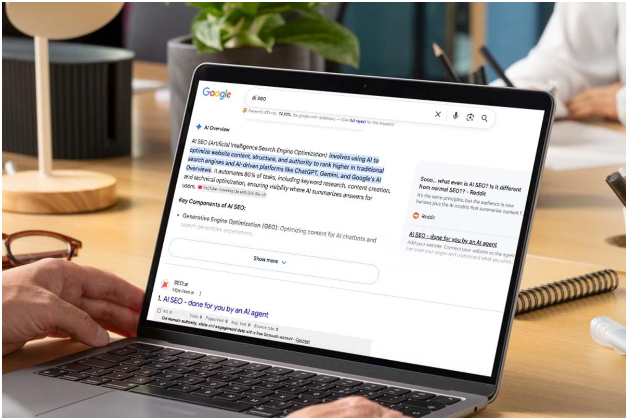
Often, when you open Google today, you'll notice something fresh at the top. Not ten blue links.
Instead, you see a concise, AI-synthesized answer with a curated carousel of sources nestled beside it. Searchers read that AI summary first. Frequently, they never scroll any further down the page.
What should a website owner or business do then?
Here is the short version: AI search optimization is about structuring your content, technical architecture, and brand authority in a manner that artificial intelligence models can readily comprehend, verify, and cite when formulating direct answers.
That's it. No mysterious tricks, no magic shortcut.
The Critical Catch Most Guides Ignore:
Visibility alone does not pay your business bills. If prospective customers land on your site and bounce without calling, submitting a form, or purchasing, you have a conversion problem, not merely an organic traffic problem. True AI search growth pairs citable content with conversion rate optimization (CRO) and high-performing web design.
What Is Search Optimization for AI?
Your web pages are optimized for AI search when they are clear, trustworthy, logically structured, and effortless to cite—giving AI search tools like Google AI Overviews, Perplexity, and ChatGPT Search the exact evidence they need to construct a reliable answer.
A Real-World Example:
Suppose a user asks: "How do I fix a leaking bathroom tap?"
Features a clear 3-step diagnosis in the first paragraph, original photos of actual plumbing jobs, transparent pricing indicators, and a verified service territory. The AI immediately parses and cites this answer.
Buries the solution beneath 800 words of poetic musings on home improvement history and vague promotional slogans. The AI model ignores it completely because extracting a factual answer takes too much computational effort.
Traditional Rankings vs. AI-Generated Replies
In classic search, businesses compete for a numeric spot on a list of blue links. In AI search, you are competing to become part of the synthesized answer itself.
Classic Search: Users click directly on a ranking link to read the page.
AI Answers: Users read an instant summary first, clicking cited source badges only when seeking deeper validation.
A webpage can hold position #1 organically yet fail to be referenced in the AI overview if its content lacks citable clarity. Conversely, a authoritative page in position #6 with clean data can be highlighted as the primary citation.
Traffic arriving via AI citations is often higher intent. These visitors have already consumed the basic summary and visit your website ready to explore specific solutions, pricing, or case studies.
Three Metrics, Not One: Visibility, Mentions & Referral Traffic
Don't lump every analytics signal into generic "traffic." In modern generative search, tracking these three distinct narrative layers is essential:
1. Organic Search Visibility
Traditional queries, search impressions, and click-through rates recorded in Google Search Console.
2. AI Brand Mentions & Citations
How frequently AI tools (ChatGPT, Gemini, Perplexity, Claude) name, recommend, or cite your company in generated answers.
3. AI Referral Traffic & Qualified Leads
Actual visitors navigating to your site from AI platform citation badges, and whether those visits convert into phone calls or deals.
What Is the Difference Between SEO, GEO, and AEO?
These three acronyms are often tossed around as if they are fierce rivals. They aren't. They are complementary tiers of the exact same growth mission.
SEO (Search Engine Optimization)
SEO focuses on helping search engine crawlers discover, index, and rank your pages. It is the bedrock of crawlability, technical performance, site architecture, and keyword intent. Skip it, and neither AI nor humans will ever find your website.
GEO (Generative Engine Optimization)
GEO optimizes content for generative AI systems (like Google AI Overviews and Perplexity) that synthesize answers from diverse sources. It relies on primary data, transparent context, and credible authorship that AI models can quote with confidence.
AEO (Answer Engine Optimization)
AEO targets direct, singular inquiries—such as featured snippets, voice search, and "People Also Ask" units. Its formula is direct: provide a crisp, accurate response in 1–2 sentences, followed immediately by supporting proof.
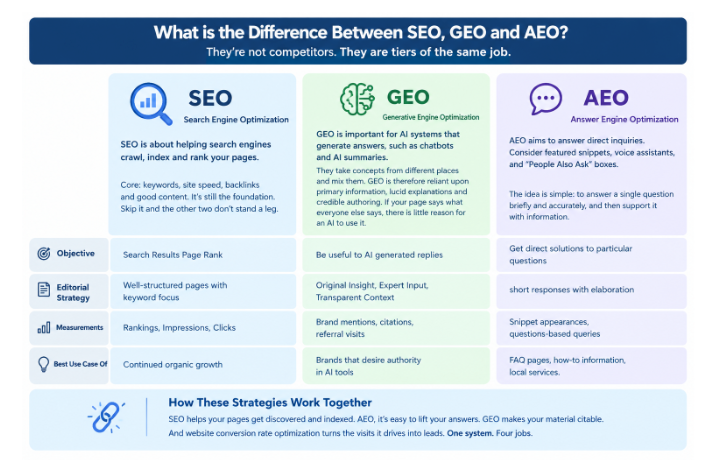
| Strategy Metric | Traditional SEO | GEO | AEO |
|---|---|---|---|
| Core Objective | Rank on Google SERP blue links | Be cited inside AI-generated replies | Provide instant answers to specific queries |
| Editorial Strategy | Well-structured pages with keyword focus | Original insight, expert input, transparent data | Short, direct responses with elaboration |
| Key Measurements | Rankings, Impressions, Organic Clicks | Brand mentions, citations, referral visits | Snippet appearances, question-based queries |
| Best Use Case | Continued compound organic growth | Brands seeking authority in generative tools | FAQ pages, how-to instructions, local services |
How These Strategies Work Together (SEO + GEO + AEO + CRO)
Think of your modern digital presence as a single engine where four distinct systems execute in unison:
SEO gets your content indexed, technically healthy, and discovered by automated crawlers.
AEO formats your answers into bite-sized nuggets so voice assistants and snippets can lift them instantly.
GEO makes your comprehensive articles trustworthy, authoritative, and irresistible for AI models to synthesize.
Website CRO converts those high-intent visitors into booked discovery calls, sales orders, and revenue.
How Do Google AI Overviews & AI Search Engines Find Useful Content?
Search systems crawl web pages (visiting their code) and index them (saving and organizing them in an enormous database). A page that is broken, sluggish, or obscured behind heavy scripts that fail to render might never enter the candidate retrieval pool.
When an AI search engine evaluates candidate pages to synthesize an answer, four foundational factors carry the most weight:
Relevance to Intent
Does the webpage directly address the exact query without digressing into irrelevant topics?
Technical Accessibility
Does the page load fast across every mobile and desktop screen without script errors?
Modular Content Structure
Is information partitioned cleanly with descriptive H2/H3 tags, concise bullet points, and data tables?
Verified Credibility
Are named authors, physical business addresses, real client feedback, and verifiable facts prominently visible?
The Honest Truth About Guarantees:
Getting featured in an AI answer is never a 100% guarantee. No agency or consultant outside of Google or OpenAI controls probabilistic neural networks. Even with flawless execution, an AI system may synthesize a rival source for a specific prompt. What you can control is dramatically stacking the odds in your favor while ensuring your website is engineered to convert every visitor who does arrive.
Step-by-Step Guide: How to Optimize Your Site for AI Search
1. First, Get to the Point
Place your core answer in the very first two sentences of the section. Explain and elaborate afterward. Human readers appreciate getting answers immediately, and large language models easily extract this as an answer candidate. A webpage that conceals its key insight beneath paragraphs of backstory is far more difficult for an AI to quote.
2. Use Specific, Descriptive Headings
Generic headings like "Our Services" or "Overview" provide zero semantic guidance. Instead, frame headings as real conversational queries: "Emergency Plumbing Repair in Sheridan, WY: Costs, Response Time & Process." This serves as an immediate UX enhancement because people scan before they read.
3. Share Original Data and First-Hand Industry Expertise
Document what your team has observed in the trenches: real client before-and-after scenarios, workflow mistakes you learned from, and proprietary benchmark statistics. First-hand proof is the very essence of Google's E-E-A-T framework (Experience, Expertise, Authoritativeness, and Trustworthiness). Generic rehashed advice is everywhere; your proprietary experience cannot be cloned.
4. Boost Author & Company Credibility Signals
- Include verified author names, professional roles, and relevant experience on all editorial content.
- Showcase verifiable certifications, industry awards, and tangible client outcomes.
- Maintain an authentic About Us page with real team members, registered entity details, and physical addresses.
- Link out to your active social channels and validated review platforms (such as Google Reviews).
5. Maintain Consistent Service & NAP Data
Your business Name, Address, Phone number (NAP), and core service capabilities must remain strictly consistent across your website, online directories, social profiles, and Google Business Profile. Discrepancies introduce entity confusion for machine algorithms and cause skepticism among human customers.
6. Add Contextual Internal Links and Authoritative References
Connect related topics through strategic internal linking. When discussing web design, link to your Web Design Services; when discussing AI solutions, route readers to AI Search Optimization. Whenever presenting factual claims or statistics, cite primary data to prove your thoroughness.
7. Review Technical Indexing & Mobile Performance
- Ensure essential revenue pages are not blocked in robots.txt or tagged with accidental "noindex" headers.
- Keep an up-to-date XML sitemap submitted in Google Search Console.
- Eliminate 404 broken links and slow asset bloat.
- Test your website thoroughly on physical mobile smartphones, not merely desktop developer emulators.
Which Content Is Best for AI Search? (And What to Avoid)
Certain formats align naturally with the conversational questions users ask search engines:
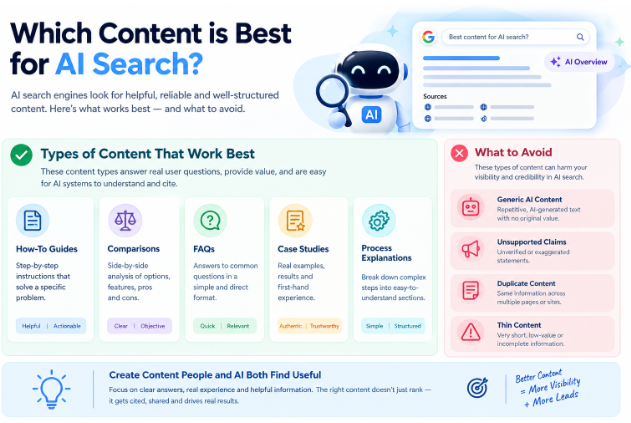
Content Types That Work Best
- Step-by-Step How-To Guides: Actionable walkthroughs that methodically resolve a distinct technical problem.
- Objective Comparisons: Side-by-side analysis of options, trade-offs, pricing, and pros/cons.
- Customer FAQs: Direct responses to high-intent transactional questions formatted in clean schema markup.
- Real Case Studies: Authentic examples with verified figures, timeline hurdles, and concrete results.
- Transparent Process Breakdowns:Clarifying complex steps, such as "What happens after you request a proposal?"
Content Mistakes to Avoid
- Generic AI Commodity Text: Repetitive, robotic filler that brings zero novel perspective to the conversation.
- Unsupported Superlative Claims:Asserting you are "the #1 agency in the world" without third-party proof or verified awards.
- Duplicate & Syndicated Content: Mirroring identical paragraphs across 50 regional landing pages.
- Thin Content: Shallow 200-word articles that fail to answer follow-up questions.
- Fake E-E-A-T Badges:Claiming "medically reviewed" or "engineer tested" without qualified human authors.
Question & Answer Format in Practice
Consider how a well-structured response is formulated for AI quotation:
"How quickly can a business expect to see conversion improvements after a website redesign?"
1. Direct Immediate Answer: Most businesses observe measurable behavioral improvements within 3 to 4 weeks following launch—provided the redesign preserves existing SEO equity and clarifies conversion pathways.
2. Factual Elaboration: The speed of statistical validation depends on traffic volume. High-traffic websites collect statistically significant conversion data rapidly, whereas low-volume sites require 60 to 90 days of iterative A/B testing.
3. Actionable Advice: Test one adjustment at a time (e.g., simplifying the checkout form or moving the primary CTA button above the fold) to pinpoint exactly what drove the conversion lift.
AI Search Visibility Measurement & Analytics
Because there isn't a single unified dashboard for AI search yet, tracking performance requires blending multiple qualitative and quantitative sources:
Google Search Console
Analyze long-tail question-style queries, impressions, and click spikes associated with AI Overviews.
Google Analytics 4 (GA4)
Monitor referral traffic originating from domains like perplexity.ai, chatgpt.com, and conversational search gateways.
Manual Prompt Audits
Conduct monthly test prompts across AI engines for your core commercial queries and record whether your brand is cited.
Branded Demand & Inquiries
Track increases in branded search volume, direct telephone calls, and demo requests from prospects who discovered your brand through AI synthesis.
Fixing the Gap: When Traffic Rises But Leads Remain Flat
If your visibility is climbing but your phone isn't ringing, audit your landing pages immediately. Effective website design for conversion is straightforward: one clear goal per page, messaging aligned with search intent, credible proof placed above the fold (customer reviews, client logos, performance statistics), and zero cognitive friction. If your basics are in place but conversion remains sluggish, partnering with a specialized conversion rate optimization agency can uncover blind spots through rigorous testing.
Checklist for AI Search Optimization
Use this practical 12-point checklist to perform an honest self-audit on your website. Check off each item your web platform currently fulfills:
1. Direct Answer in Opening Words
Each essential page addresses its core inquiry within the first few sentences without fluff.
2. Specific, Question-Based Headings
Subheadings reflect real customer questions rather than vague corporate jargon.
3. Clean Technical Indexation
Important pages are verified as indexed in Google Search Console with zero accidental blocks.
4. No Blocked Crawlers in robots.txt
Critical search bots and AI crawlers are permitted without accidental 'noindex' or header restrictions.
5. Transparent Author & Company Profiles
Articles showcase clear author bylines, verified bios, credentials, and publication dates.
6. Consistent Business NAP Details
Business Name, Address, Phone number, and service definitions are identical across web, directories, and social profiles.
7. Clear Service Scope & Timelines
Service pages detail realistic pricing tiers, deliverable roadmaps, and execution processes.
8. Original Case Studies & Evidence
Real first-hand client situations, before-and-after results, and verified performance benchmarks.
9. Contextual Internal Linking
Related topics are deeply interlinked to guide readers and assist semantic crawlers.
10. Claims Backed by Credible Sources
Factual statements, industry statistics, and benchmarks cite authoritative primary research.
11. Mobile Speed & Core Web Vitals
Site loads rapidly and renders flawlessly on smartphones where mobile conversion rates matter most.
12. One Clear, Compelling Call to Action
Action-oriented CTAs with prominent buttons and frictionless inquiry forms on every landing page.
Want to Turn AI Search Visitors Into High-Value Clients?
Simplify your inquiry forms, make your telephone numbers immediately clickable, and eliminate friction between interest and action.
Frequently Asked Questions (FAQ)
Common questions from business owners and marketers adapting their digital strategy to generative search:
Conclusion: The Future Belongs to Clear, Citable Brands
AI search is transforming the way people discover businesses. But the foundational principle has not altered: be straightforward, be authentic, and provide genuine benefit.
Get found through structured clarity, then make it effortless for visitors to take action. Take the checklist above, address your most glaring site weaknesses, and measure progress month over month. Grandiose promises never outlast consistent, compounding execution.
Ready to engineer an AI search growth strategy?
Speak directly with AutoByte Solution's senior growth and SEO engineers.