What Is Conversion Rate Optimization? CRO Best Practices
The ultimate CRO best practice guide to boost your revenue. Learn proven tactics to convert more of your existing visitors into paying customers and qualified leads.
AutoByte Conversion Engineering & Growth Team
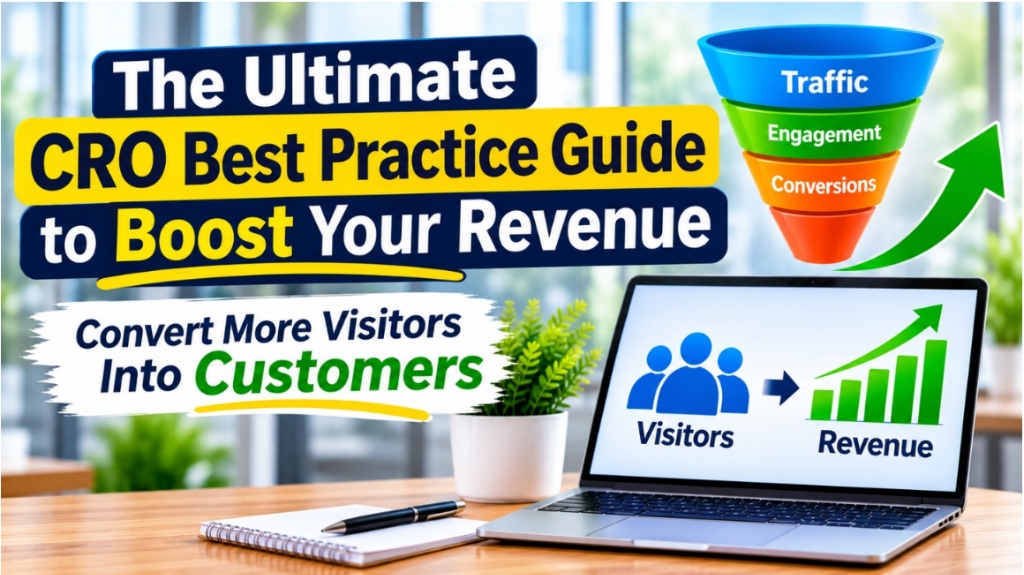
The Ultimate CRO Best Practice Guide to Boost Your Revenue
You’ve invested heavily in search engine optimization, launched paid advertising campaigns, and posted consistently across social media. Website traffic numbers are climbing on your analytics dashboard — but revenues, qualified leads, phone inquiries, and bookings remain stubbornly flat.
In almost every modern digital business, the frustrating discrepancy between website visitors and paying customers is a conversion problem, not a traffic problem. Pouring more ad dollars into a website that fails to engage and convert simply inflates your customer acquisition cost (CAC).
Conversion Rate Optimization (CRO) is the systematic, data-backed discipline of extracting compounding revenue from the traffic your business is already attracting. In this comprehensive guide, you will discover what CRO is, why it matters, which proven best practices generate the highest financial return, and how to select the right conversion rate optimization services partner for your growth goals.
What Is CRO – Conversion Rate Optimization?
Conversion rate optimization is a methodical, data-driven process of increasing the percentage of website visitors who complete a desired, revenue-producing action. That conversion action might be an e-commerce checkout purchase, an inquiry form submission, an inbound phone call, an enterprise software demo request, or an email newsletter signup.
The Fundamental Conversion Rate Formula
SEO vs. CRO vs. PPC: How They Work in Synergy
Successful marketing strategies do not treat SEO, paid advertising, and CRO as isolated silos. These three pillars act in concert to construct an end-to-end customer acquisition pipeline:
| Channel | Primary Function | Cost Structure | Key Metric |
|---|---|---|---|
| SEO (Search Engine Optimization) | Drives organic, unpaid traffic from search engines and AI answer engines. | Long-term upfront investment with compounding returns | Organic Traffic & Rankings |
| PPC (Pay-Per-Click Advertising) | Purchases immediate, targeted traffic through paid search ads and social campaigns. | Pay-per-click or impression; stops when ad spend stops | Cost Per Click (CPC) & ROAS |
| CRO (Conversion Rate Optimization) | Converts that incoming traffic into paying customers, qualified leads, and bookings. | Permanent asset enhancements with compounding ROI | Conversion Rate & Revenue Per Visit |
Why You Should Be Optimizing Your Website Conversion Rate
Improving your website’s conversion architecture delivers measurable benefits that multiply your bottom-line profitability without demanding more marketing spend:
Significantly Reduced Cost Per Lead
The more website visitors who convert, the lower your acquisition cost for every customer becomes. If you run Google or Meta ads where every click costs real money, higher conversion rates directly slash your customer acquisition costs (CAC).
More Revenue from Existing Traffic
Growing search and ad traffic is sluggish, competitive, and expensive. If you increase your conversion rate from 2% to 3%, you unlock an immediate 50% lift in sales and leads from the exact same audience size without spending an additional penny on media.
Superior User Experience (UX)
CRO succeeds by uncovering exactly how real human visitors interact with your web pages. The tactics that solve conversion drop-offs — faster page load speeds, clearer messaging, intuitive mobile forms — elevate the digital experience for every visitor.
Compounding Competitive Returns
Every A/B test provides verified behavioral insights about what your target audience values. These cumulative learnings compound across subsequent product launches, marketing emails, and ad campaigns, creating an insurmountable competitive moat.
5 Core Best Practices for Conversion Rate Optimization
While every business and audience requires customized testing, these five fundamental best practices consistently produce the highest conversion improvements across B2B, e-commerce, and service-based websites:
Clear CTAs and Focused Landing Pages
Each page should have one singular, unmistakable objective. Use action-oriented button text ('Get My Free Audit' instead of generic 'Submit'). Position CTAs where user attention naturally peaks, and ensure headlines, copy, and graphics all reinforce the exact same next step. Eliminate extraneous navigation links and visual clutter on dedicated campaign landing pages.
Key Action Items:
- ✓Use first-person, benefit-driven button copy
- ✓Place primary CTAs both above the fold and at key evaluation milestones
- ✓Strip header and footer navigation on paid traffic landing pages
Mobile-First Architecture & Rapid Page Speed
The overwhelming majority of users browse on smartphones, and sluggish mobile pages hemorrhage potential buyers within seconds. Prioritize Google's Core Web Vitals: Largest Contentful Paint (LCP < 2.0s), Interaction to Next Paint (INP < 200ms), and Cumulative Layout Shift (CLS < 0.1). Optimize images to modern WebP/AVIF formats, minimize render-blocking scripts, and engineer large, thumb-friendly tap targets and form fields.
Key Action Items:
- ✓Compress and size all imagery for mobile viewports
- ✓Optimize touch targets (minimum 44x44px) and input field spacing
- ✓Eliminate layout shifts caused by dynamic banners or unreserved image containers
Prominent Social Proof & Risk Reversal
When visitors are uncertain about a company's reliability, they hesitate to purchase or submit an inquiry. Disarm skepticism immediately by embedding verified client ratings, customer and partner logos, data-backed case studies with before-and-after metrics, security compliance badges, clear satisfaction guarantees, and prominently displayed, transparent contact information.
Key Action Items:
- ✓Showcase real client testimonials with names, photos, and company titles
- ✓Display third-party trust badges (Clutch 5.0, Google Reviews, DesignRush, Bark)
- ✓Highlight risk reversals like satisfaction guarantees and clear privacy statements
Streamlined Forms and Frictionless Checkout
Every superfluous form field or extra checkout step gives buyers a reason to bounce. Request strictly the information essential for first contact or fulfillment. Use clear floating labels, helpful inline validation, real-time error hints, and browser autofill support. For e-commerce stores, offer frictionless guest checkout alongside multiple modern payment options (Apple Pay, Google Pay, PayPal, Shop Pay).
Key Action Items:
- ✓Cut non-essential fields (reduce lead forms from 8+ fields to 3–4)
- ✓Enable one-click digital wallets (Apple Pay, Google Pay)
- ✓Provide immediate inline feedback on input validation errors
Rigorous A/B Testing: Test Everything
Opinions and aesthetic preferences fail to drive conversions; empirical user behavior does. Split testing (A/B testing) compares two variations of a page or specific element (headline, value proposition, button color, form layout, offer structure) to identify which statistically generates more conversions. Always change one critical variable per test and run campaigns long enough to reach statistical significance.
Key Action Items:
- ✓Test one core variable at a time (headline, CTA offer, or page layout)
- ✓Run experiments until reaching 95%+ statistical confidence
- ✓Carefully log test results and apply proven lessons across site architecture
Ecommerce CRO Services: Best Practices for Online Stores
Online retail brands face distinctive conversion challenges, from high cart abandonment rates to hesitant mobile shoppers. Dedicated e-commerce CRO services concentrate heavily on three critical milestones:
Product Page Optimization
- • High-resolution lifestyle imagery and short video walkthroughs
- • Transparent pricing, shipping costs, and return policies
- • Benefit-led copy highlighting outcomes rather than feature lists
- • Visible customer review badges and verified user ratings
- • Clear inventory urgency and stock transparency
Cart & Checkout Streamlining
- • Minimal checkout steps accompanied by a visible progress indicator
- • Zero unexpected fees, shipping surprises, or taxes at final step
- • Prominent security badges directly adjacent to credit card inputs
- • Effortless cart quantity editing without reloading the page
- • One-click digital wallet support (Shop Pay, Apple Pay, Google Pay)
Cart Abandonment Reduction
- • Address checkout friction first before relying on recovery tools
- • Eliminate forced account registration; default to guest checkout
- • Automated 3-stage email recovery series within 1, 24, and 72 hours
- • Strategic exit-intent modals offering real-time assistance or discounts
- • Dynamic retargeting campaigns showcasing abandoned items
How a Conversion Rate Optimization Audit Works
Every genuine, data-backed CRO engagement commences with an exhaustive diagnostic audit. A typical professional CRO audit follows this structured 5-step workflow:
Search Trends & Competitor Funnel Audit
Analyze how incoming visitors discover your website, what search intent they arrive with, and how top direct competitors position their offers and landing pages.
Keyword & Intent Mapping
Ensure every landing page precisely matches the real problem the visitor searched for, so visitors land on targeted answers rather than generic homepages.
Tracking & Analytics Verification
Audit Google Analytics 4 (GA4), Google Tag Manager, custom conversion events, and ad pixels. You cannot improve what you are not accurately measuring.
Behavioral Analysis & Heatmaps
Deploy session recordings, heatmaps, and funnel drop-off reports to observe real customer hesitation, rage clicks, and where high-intent buyers leave.
Prioritized Testing & Site-Wide Scaling
Develop hypothesis-backed A/B tests, execute high-impact experiments first using the ICE framework, and roll winning variations out permanently.
CRO Services: Agency vs. Consultant vs. In-House Team
Choosing how to resource your CRO initiatives depends on your traffic volume, budget, and internal technical capabilities:
| Delivery Model | Best Suited For | Key Strengths | Limitations |
|---|---|---|---|
| CRO Consultant | Small businesses or marketing teams needing strategic direction with in-house developers. | Cost-effective, highly specialized, agile advisory | Limited execution bandwidth; reliant on your team for coding and design |
| CRO Agency (e.g. AutoByte Solution) | Companies wanting strategy, UI/UX design, full-stack development, and analytics under one roof. | End-to-end execution, dedicated testing software, multidisciplinary team | Higher monthly retainer than solo contractors |
| In-House CRO Team | Large enterprises with 100k+ monthly visitors and continuous multi-channel testing needs. | Deep institutional knowledge, full internal focus | Substantial payroll overhead, software licensing costs, hiring delays |
What to Expect from Conversion Rate Optimization Experts
A credible CRO specialist or agency should never rely on hunches, vanity redesigns, or generic templates. Legitimate conversion experts provide:
- ✓A test-based, empirical procedure rooted strictly in analytics and user data, never subjective guesswork.
- ✓Demonstrated experience in your specific industry or business model (B2B SaaS, e-commerce, local services).
- ✓Cross-functional competence combining quantitative analytics, UX design, persuasive copywriting, and engineering.
- ✓Radical transparency about what can and cannot be promised — honest experts test hypotheses rather than claiming overnight guarantees.
Choosing the Right CRO Agency: The Vetting Checklist
Before signing an agreement with a conversion rate optimization company, use this vetting checklist to protect your investment:
Verified Case Studies with Context
Do they showcase genuine, authenticated client outcomes with detailed explanations of how the conversion lift was achieved?
Transparent Business Reporting
Will reporting tie directly to gross revenue, qualified pipeline, and sales orders, rather than superficial vanity metrics like click rates?
Transparent, Predictable Pricing
Are service tiers, project audits, and monthly retainer deliverables clearly defined with zero hidden fees or surcharges?
Realistic, Empirical Timelines
Beware of any vendor promising instant doubling of sales. Reliable CRO is an iterative scientific process that builds over 60–90 days.
100% Asset & Data Ownership
Do you retain unilateral ownership of all analytics configurations, testing scripts, heatmaps, and design assets if you ever part ways?
Audit-First Engagement Model
Do they perform quantitative analytics and user research before proposing changes, rather than jumping straight into aesthetic redesigns?
Summary: Turn More Visitors into Lifelong Customers
Conversion rate optimization remains one of the single most cost-effective strategies for scaling business revenue without inflating advertising budgets. When you deeply understand your visitors’ motivations, systematically eliminate user friction, establish rock-solid brand trust, and test iteratively, you turn your existing website into an automated, predictable customer generation engine.
Partner with AutoByte Solution for Full-Funnel CRO
AutoByte Solution combines UX research, high-speed Next.js frontend development, persuasive copywriting, and data-driven A/B testing to help ambitious brands convert more traffic into revenue.
AutoByte Conversion Engineering & Growth Team
Full-Funnel CRO & Performance UX Specialists
AutoByte Solution engineers high-converting landing pages, seamless e-commerce checkouts, and behavioral A/B testing frameworks that transform digital traffic into compounding revenue.