How to Choose the Right SEO Company for Your Business
Learn how to choose the right SEO company for your business, what questions to ask, which red flags to avoid, and how to evaluate SEO agencies.
AutoByte SEO Team

Choosing an SEO partner can feel surprisingly difficult. Search for an SEO company online and you’ll find hundreds of agencies promising better rankings, more traffic, and faster growth. On the surface, many of them appear to offer exactly the same thing.
The difference becomes clear after you start asking the right questions.
What True SEO Partnership Means:
A reliable SEO company should do more than improve keyword positions. It should understand your business, identify what is limiting your organic visibility, develop a realistic strategy, and connect SEO activity with meaningful business outcomes.
If you're wondering how to choose the right SEO company, this guide explains what to evaluate, which questions to ask, and which warning signs should make you reconsider an agency before signing a contract.
What Does an SEO Company Actually Do?
An SEO company helps businesses improve their visibility in organic search results and attract people who are actively looking for their products, services, or expertise.
But professional SEO services involves considerably more than adding keywords to website pages. Depending on your website and goals, an SEO strategy may involve:
The right combination depends on the business. A local service company, for example, may need significant attention on local search visibility, while an eCommerce business may have much larger technical, category-page, product-page, and site architecture requirements.
That is why choosing an SEO company should start with strategy rather than a package.
Why Choosing the Right SEO Company Matters?
SEO compounds over time. Good decisions made today can continue generating traffic and leads months or even years later. Poor decisions can create the opposite effect.
The Danger of Weak or Careless SEO:
Weak SEO work can result in irrelevant traffic, low-quality content, technical problems, wasted marketing budgets, poor-quality backlinks, and pages competing against one another (keyword cannibalization). In some cases, aggressive or spammy tactics can create penalties that take considerably longer to correct than they took to implement.
The objective therefore isn't simply to find someone who "does SEO." You want a partner that understands how search visibility supports your broader business goals.
How to Choose the Right SEO Company: 10 Things to Evaluate
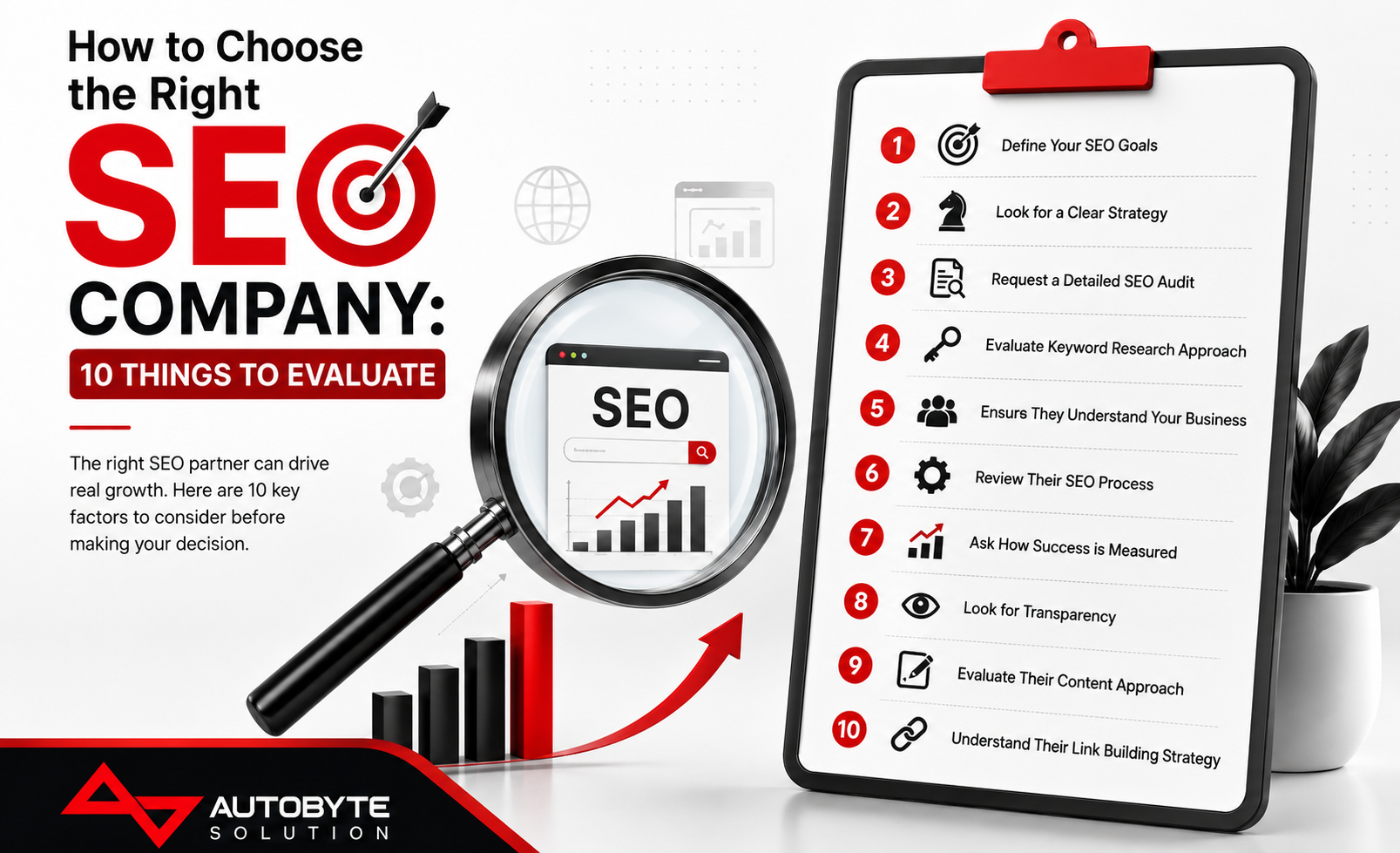
Before comparing SEO companies, determine what you actually want SEO to accomplish. "We want more traffic" is usually too broad. Better objectives might include:
- • Generate qualified organic leads
- • Increase eCommerce sales
- • Improve visibility in specific markets
- • Generate more local inquiries
- • Increase non-branded search traffic
- • Improve visibility for high-value services
- • Recover declining organic performance
- • Build authority within a particular industry
For example, a company specializing primarily in local SEO may be an excellent fit for a multi-location service business but less appropriate for a large SaaS platform requiring international technical SEO.
Most SEO companies can provide a familiar list: Keyword research. Technical SEO. Content. Link building. Reporting. That doesn't tell you much. The important question is: How will those activities work together for your business?
A Strategic Agency Response Looks Like:
“Your service pages aren't sufficiently aligned with commercial search intent, several important pages have weak internal authority, and competitors have substantially stronger supporting content. We'd address those areas before expanding into additional keyword clusters.”
That demonstrates thinking. SEO shouldn't feel like purchasing a checklist every month. It should feel like executing a strategy.
Before prescribing a solution, an SEO company needs to understand the problem. That's where an SEO audit becomes important. A professional audit may examine:
Technical Health
Crawlability, indexing, redirects, canonicals, duplicate content, schema, mobile usability, performance.
On-Page SEO
Titles, headings, content relevance, keyword targeting, internal linking, and search intent alignment.
Content & Topical Depth
Topical coverage, quality, outdated pages, content gaps, and search opportunity clusters.
Authority & Conversions
Backlink profile, referring domains, competitor moats, and whether organic traffic converts into revenue.
Keyword research isn't about collecting phrases with the largest search volume. The best keywords sit at the intersection of:
Keyword A: 10,000 searches/mo
Broad informational interest with virtually zero buying intent.
Keyword B: 700 searches/mo
High commercial intent from buyers actively evaluating and ready to sign.
Keyword B could be considerably more valuable. Ask how keywords will be mapped to pages to prevent cannibalization.
SEO cannot operate independently from the business it supports. Before proposing a strategy, an agency should explore:
- • Your products or services
- • Ideal customer profile (ICP)
- • Highest-margin offerings
- • Target geographic locations
- • Sales cycle and close process
- • Major direct competitors
- • Current conversion channels
- • Historical website performance
If the conversation immediately becomes "We offer 20 blogs and 100 backlinks every month" before asking what your business accomplishes, that is a red flag.
Ask prospective agencies to explain what happens after you hire them. A mature framework looks like:
SEO isn't a one-time project. Competitors publish new content, algorithms shift, and search behavior evolves. Your strategy should evolve too.
Rankings matter, but rankings alone shouldn't determine whether SEO is working. Consider monitoring:
| Metric | What It Helps Measure |
|---|---|
| Organic visibility | Overall search presence |
| Keyword rankings | Position changes for target searches |
| Organic clicks | Traffic arriving from search |
| Impressions | Search exposure |
| CTR | How effectively listings attract clicks |
| Organic leads | Inquiries generated through SEO |
| Organic revenue | Revenue attributed to organic search |
| Conversion rate | Quality and effectiveness of organic traffic |
| Local visibility | Performance in geographically relevant searches |
Ask the SEO company: "How will you connect SEO performance to our actual business goals?"Their answer tells you everything.
You should know what your SEO company is doing. Good reporting should concisely answer:
A 30-page automated PDF filled with graphs isn't transparency. Clear business communication is.
Content has become one of the easiest areas for agencies to scale—and one of the easiest areas to get wrong. Ask how content topics are selected.
Be cautious if the entire pitch is "We'll publish 30 AI-generated articles every month." Strong content should answer the searcher's question while demonstrating genuine first-hand expertise, experience, and commercial relevance.
Backlinks contribute to search authority, but link quality matters far more than volume. One meaningful editorial mention from an authoritative industry source is worth hundreds of directory links.
Red Flags When Choosing an SEO Company
Some warning signs deserve particular attention. If you encounter any of these, pause before signing a retainer:
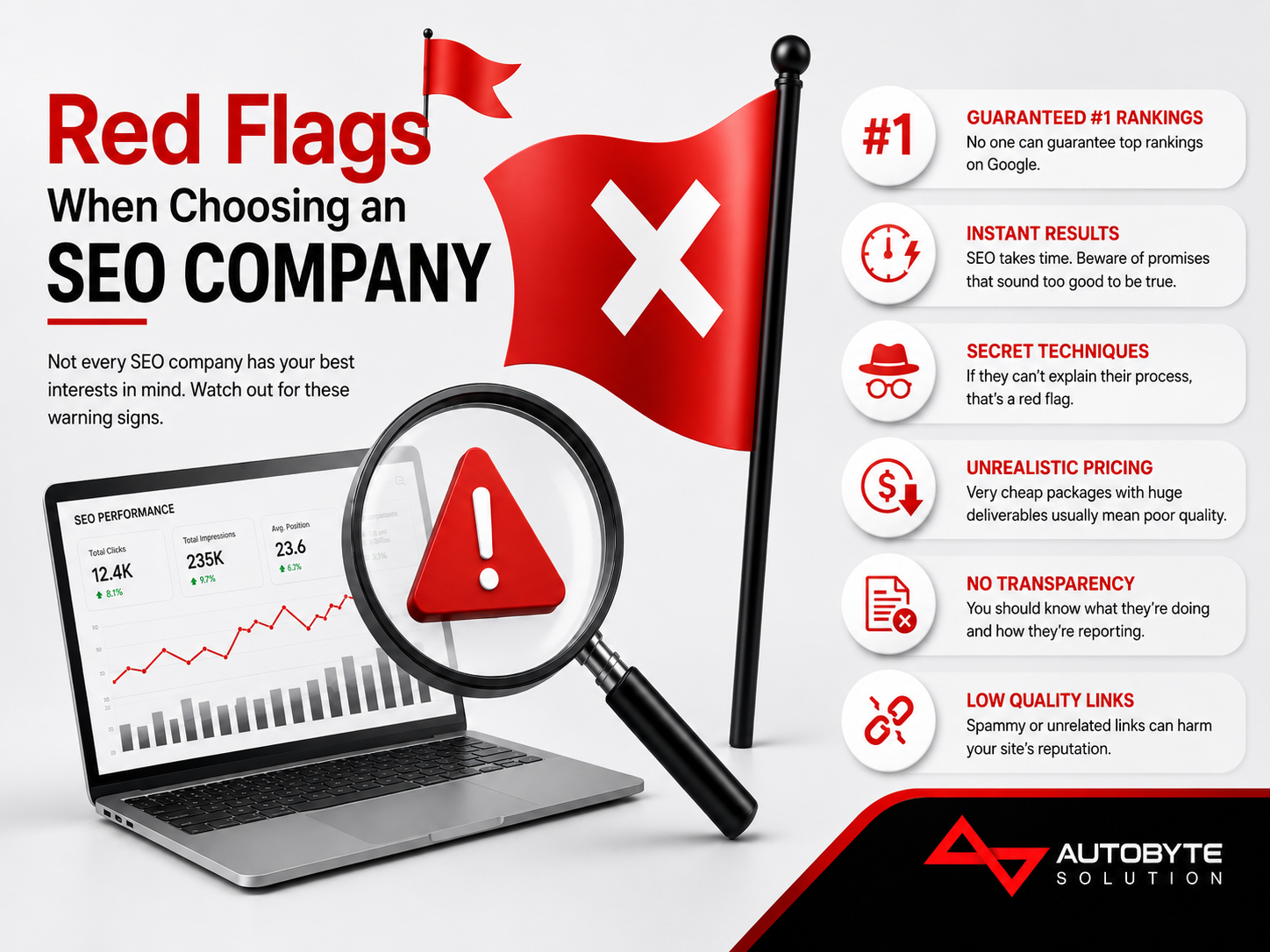
1. Guaranteed #1 Google Rankings
No legitimate SEO company controls Google's ranking algorithms. An agency can improve probability; it cannot responsibly guarantee position #1.
2. "Instant SEO Results"
Some fixes show quick lift, but meaningful organic market capture takes sustained compounding. Beware of overnight promises.
3. Secret SEO Techniques
An agency should be able to explain its strategy without pretending it possesses a mysterious, proprietary ranking formula.
4. Extremely Cheap Packages with Huge Deliverables
If an offer includes dozens of articles, thousands of backlinks, and full technical optimization for an unrealistically low price, investigate how that work is produced.
5. No Access to Your Data
Your business should always retain ownership and administrative access to Search Console, Google Analytics, ad accounts, and website code.
6. Reporting Only on Vanity Metrics
Large increases in impressions sound great. But if they don't produce qualified leads, sales, or revenue, they have zero business value.
Questions to Ask Before Hiring an SEO Company
Before signing any agreement, run prospective partners through this 12-question interview:
Don't judge agencies only by whether they provide the answer you want to hear. Evaluate whether they can explain why their answer makes business sense.
SEO Freelancer vs SEO Company: Which Should You Choose?
Neither option is automatically better. An experienced freelancer can be an excellent choice for smaller projects or businesses needing targeted, specialized expertise.
An SEO company becomes essential when the project requires several disciplines simultaneously:
If your SEO bottlenecks overlap with website architecture, conversion optimization, or modern web frameworks, working with a multidisciplinary agency simplifies execution.
How Much Should You Pay an SEO Company?
There isn't a universal price because scope varies considerably. Pricing depends on:
- • Website size & architecture
- • Niche competition density
- • Geographic market reach
- • Technical complexity
- • Content production scale
- • Link acquisition requirements
- • Domain authority status
- • Historical penalty recovery
- • Specific revenue targets
The Question to Ask:
Instead of asking only "How much does SEO cost?", ask: "What are we paying for, why do we need it, and how will it contribute to our revenue objectives?"
What Should the First 90 Days Look Like?
Although every campaign differs, the beginning of an engagement should prioritize deep understanding and technical foundations:
Discover
Analyze the website, competitors, technical crawl health, keywords, content, backlink profile, analytics accuracy, and business objectives.
Prioritize
Fix high-impact technical issues, map high-intent keywords, optimize high-priority pages, establish conversion tracking, and create the content roadmap.
Expand
Execute broad content clusters, authority-building campaigns, strategic internal linking, ongoing technical tuning, and conversion rate opportunities.
After 90 days, SEO transitions into a continuous cycle: Measure → Learn → Improve → Expand
Don't Choose an SEO Company Based on Rankings Alone
This sounds counterintuitive. If an SEO company ranks first for a competitive keyword, that's certainly evidence worth considering. But it shouldn't be the only evidence.
Always evaluate the complete picture: Strategy. Expertise. Communication. Transparency. Process. Business understanding.
An agency might be excellent at ranking its own domain while being poorly suited to your industry or business model. Choose based on overall strategic fit.
What Does the Right SEO Company Look Like?
The right SEO partner should make your strategy clearer, not more confusing. They should be willing to explain what isn't working, where the opportunities are, what should be prioritized, and how progress will be measured.
The Growth Chain Reaction:
• Rankings create visibility.
• Visibility creates opportunities for traffic.
• Relevant traffic creates opportunities for conversions.
• And conversions are what turn SEO into business growth.
At AutoByte Solution, our SEO consulting approach starts by understanding the problems behind your current search performance. From technical SEO and content strategy to keyword targeting, authority building, and ongoing measurement, we develop an actionable roadmap around your business rather than forcing your website into a predefined package.
The Closing Question
Are your current SEO activities simply increasing metrics, or helping move your business forward?
AutoByte SEO Team
Search Architecture & Growth Strategy
AutoByte Solution engineers data-backed search strategies, technical SEO foundations, and revenue-focused organic campaigns for growth-stage businesses.