Will AI Replace Web Developers? What the Future of Web Development Actually Looks Like
Explore what AI can automate, what still requires human developers, and how AI is changing the future of web development.
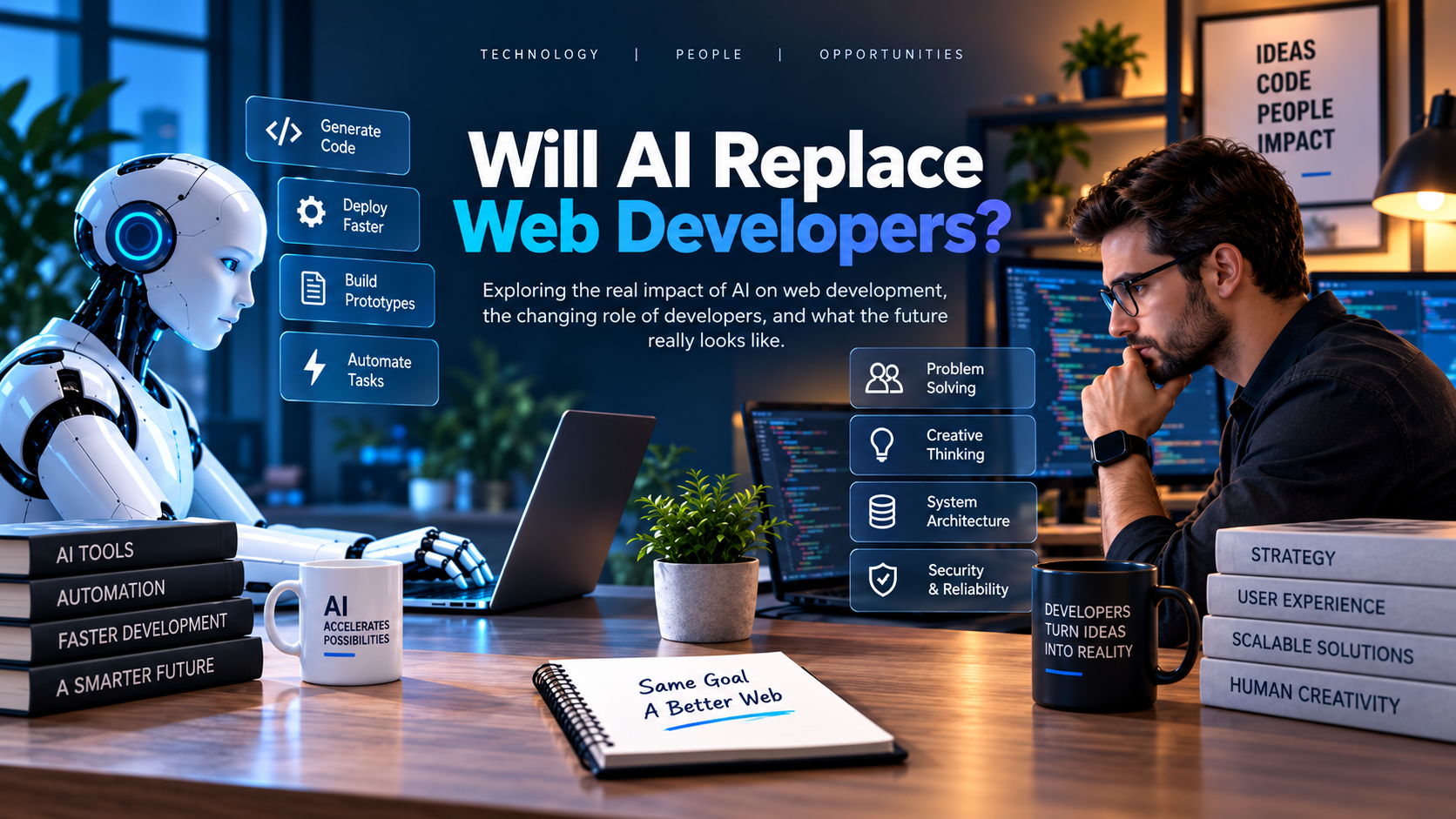
A few years ago, building even a relatively simple website required someone to manually write HTML, CSS, and JavaScript, configure servers, manage databases, and wire up APIs. Today, a text prompt can generate something that visually resembles a website in minutes. But will AI completely replace web developers? The short answer is unlikely, but AI will radically transform the day-to-day work of engineers. The future is not "AI vs. Developers"—it is developers who master AI surpassing those who do not.
Using or Planning AI
Of surveyed developers in 2025 use or plan to use AI tools in their engineering workflows.
Daily Professional Use
Of professional engineers actively rely on AI coding assistants on a day-to-day basis.
Distrust AI Accuracy
Of developers actively distrust AI accuracy, compared with only 33% who trust it.
'Almost Right' Frustration
Cite AI code that is 'almost right, but subtly wrong' as one of their biggest productivity drains.
1. Will AI Replace Web Developers?
AI is far more likely to fundamentally change web development than eliminate developers altogether. To understand why, one must separate two distinct activities:
Writing Code
Typing repetitive syntax, loops, CSS rules, and component markup into an IDE editor.
Engineering Software Systems
Designing architectures, securing databases, handling edge cases, integrating business APIs, and ensuring uptime.
Suppose a company asks for an online booking platform. AI can quickly generate login fields, a date picker, and a SQL table. But real software engineering asks the questions a prompt omits:
- ✓What happens under a race condition when two visitors reserve the exact same slot at the identical millisecond?
- ✓What happens when the payment processor charges the card but the downstream calendar webhook drops?
- ✓How are HIPAA or GDPR privacy regulations enforced across multi-tenant database records?
- ✓How does the server infrastructure scale when promotional traffic surges 50x in twenty minutes?
For a detailed breakdown of what goes on behind the scenes, read our foundational guide: What Web Developers Do: Roles, Responsibilities, Skills, and How Websites Actually Get Built.
2. What Can AI Already Do in Web Development?
AI capabilities should never be underestimated. Modern LLMs and coding agents are remarkably capable at accelerating everyday developer tasks:
Code Generation
Generating boilerplate HTML5, CSS layouts, React/Next.js components, TypeScript types, and SQL queries from plain-language prompts.
Rapid Debugging
Analyzing stack traces, compiler errors, and unexpected console outputs to pinpoint potential causes and logic flaws.
Code Refactoring
Modernizing legacy JavaScript into idiomatic TypeScript, simplifying nested conditionals, and recommending design patterns.
Documentation & Summaries
Parsing unfamiliar repositories, generating function docstrings, and summarizing changelogs for pull requests.
Automated Testing
Scaffolding unit tests, edge-case assertions, integration test skeletons, and realistic mock database payloads.
Hyper-Fast Prototyping
Turning a wireframe or napkin sketch into an interactive demo within hours instead of weeks, changing development economics.
3. What Parts of Web Development Are Most Likely to Be Automated?
Not all engineering work carries identical cognitive weight. Routine, repetitive tasks will see the heaviest degree of AI automation:
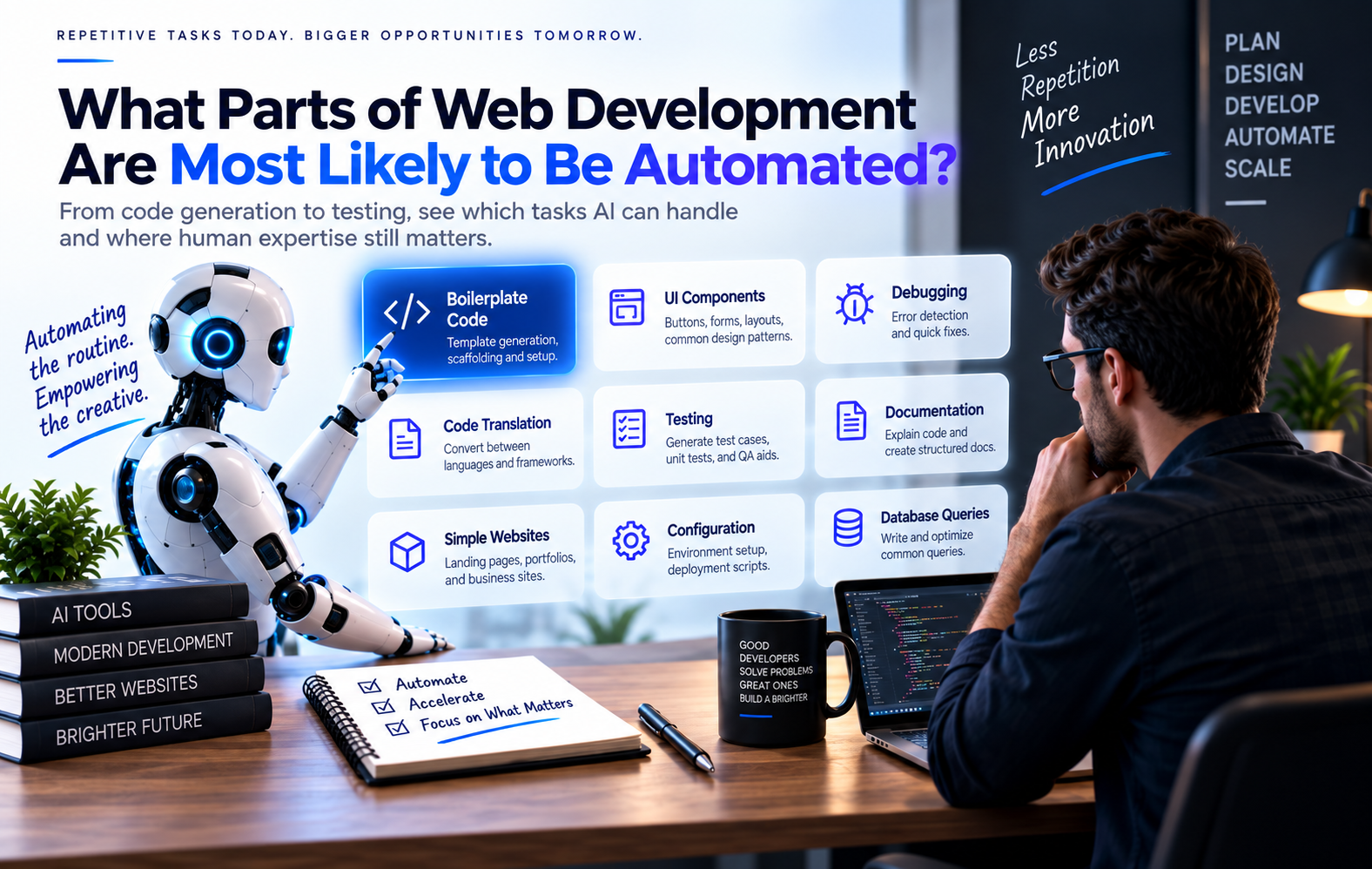
High Automation Potential
- •Repetitive CRUD boilerplate operations
- •Form structures and standard client validation
- •Basic UI components (cards, accordions, pricing tables)
- •Converting code between languages (JS to TS)
- •Drafting initial unit test cases and mock data
- •Standard documentation summaries and changelogs
Requires Human Engineering Judgment
- •Complex distributed system architecture and scalability
- •Multi-tenant security, permissions, and zero-trust AuthZ
- •Race condition prevention and concurrency locks
- •Translating ambiguous business goals into technical requirements
- •Live zero-downtime database migrations on large datasets
- •Incident response, root cause analysis, and production accountability
4. Why AI Is Unlikely to Completely Replace Web Developers
There is a fundamental logical flaw in the premise: "AI can output a web page, so businesses don't need developers."
A successful digital product involves an intricate chain of continuous decisions:
AI tools generate snippets of code along this chain. But humans are required to connect the chain, test the links, and guarantee that the bridge won't collapse when traffic crosses it.
5. AI-Generated Code vs. Production-Ready Software
This is the single most crucial distinction in the entire debate. Creating a flashy demo is fast; preparing software to handle real users and sensitive transactions is entirely different:
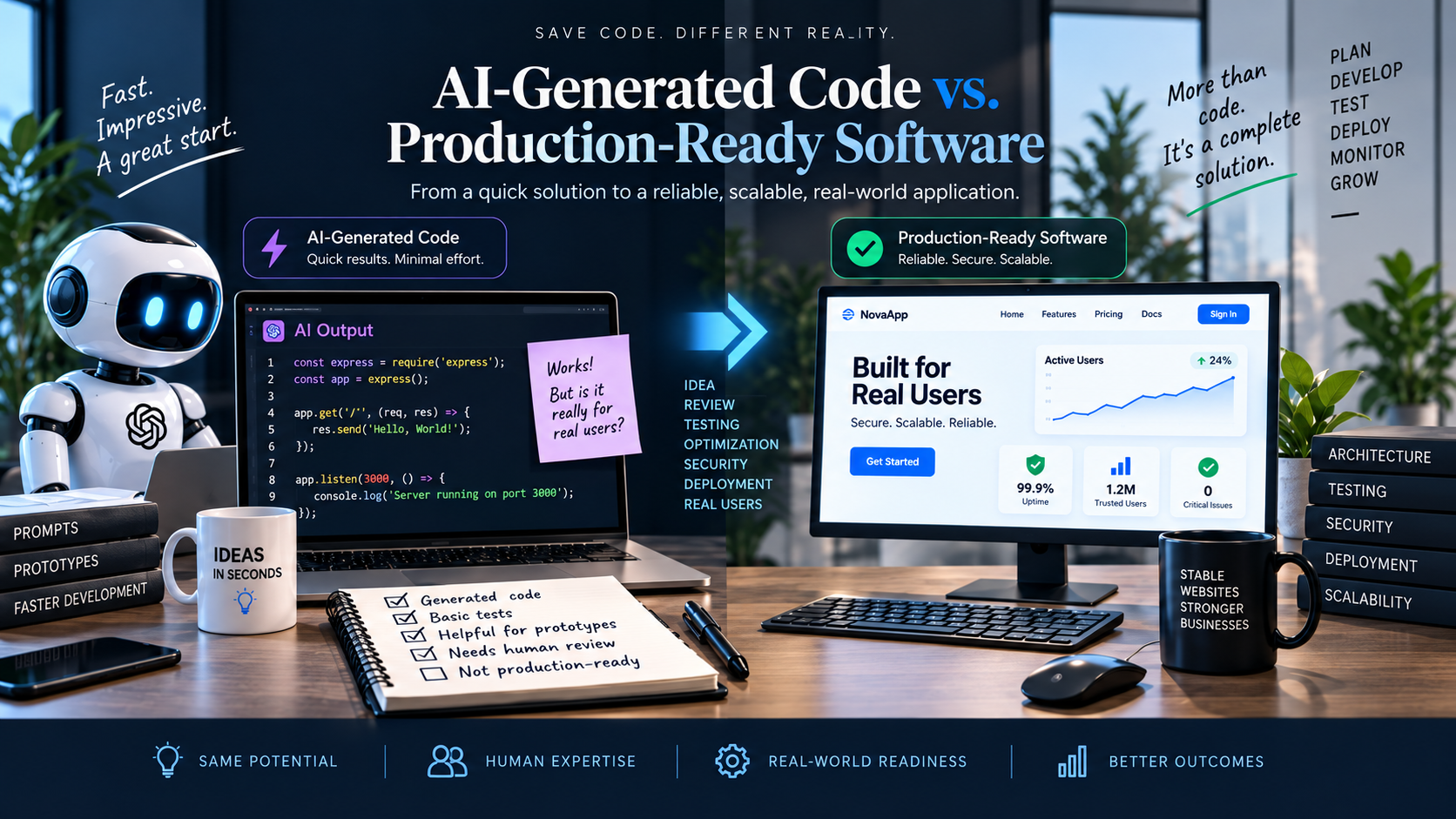
| Dimension | AI-Generated Code (Demo) | Production-Ready Software |
|---|---|---|
| Operating Context | Works on localhost with 1 user and mock data. | Operates under high concurrency, real network latency, and distributed servers. |
| Failure Handling | Assumes the "happy path" always succeeds. | Implements circuit breakers, retries, idempotent webhooks, and graceful degradation. |
| Security Posture | Often lacks sanitization, rate-limiting, and AuthZ. | Hardened against SQLi, XSS, CSRF, credential stuffing, and session hijacking. |
| Speed & Vitals | Standard unbundled scripts that may shift layout. | Optimized Core Web Vitals (sub-2.5s LCP, sub-200ms INP) for search rank protection. |
The "Almost Right" Trap
In Stack Overflow's 2025 survey, 66% of developers reported frustration with AI code that is "almost right, but not quite." If an LLM generates homepage CSS that is 95% accurate, you can tweak the remaining 5% easily. But if it is 95% accurate on Stripe checkout payment logic, database concurrency, or HIPAA patient authorization, that missing 5% can cause devastating legal and financial catastrophes. Software does not receive partial credit for looking plausible.
6. Will AI Replace Front-End Developers?
Front-end development is experiencing heavy automation. AI tools can turn Figma screenshots into functional Tailwind and React components in seconds.
Does this mean front-end developers disappear? No. It means their role shifts from manually typing CSS selectors to architecting application state, enforcing WCAG accessibility standards, fine-tuning browser performance, managing client caches, and preventing cumulative layout shifts (CLS).
A capable front-end engineer using AI will simply deliver four times more polish, speed, and responsiveness than was previously possible.
7. Will AI Replace Back-End Developers?
Back-end systems contain everything users don't see—and businesses cannot afford to fail. Generating an Express API route takes 15 seconds. Knowing whether that route will lock the database when 50,000 users query it simultaneously requires senior engineering wisdom.
Back-end engineers will use AI to draft schemas and write boilerplate integrations, but high-stakes decisions around data integrity, distributed caching, security isolation, and disaster recovery will remain firmly anchored in human hands. Explore our Custom Web Development Services to see how we engineer secure backend solutions.
8. Will AI Replace Full-Stack Developers?
Full-stack developers are perhaps the greatest beneficiaries of the AI revolution.
AI dramatically lowers the context-switching penalty between different languages. A frontend specialist can quickly verify Python scripts; a backend engineer can prototype clean UI layouts. Experienced full-stack developers can now direct AI across the entire spectrum—from Next.js to PostgreSQL—allowing lean engineering squads to build enterprise platforms that previously required dozens of specialists.
9. What Happens to Junior Web Developers?
Junior developers face the most significant transition. Traditionally, entry-level programmers learned their craft by writing basic forms, adjusting CSS paddings, and writing simple CRUD functions—the exact tasks AI automates first.
The Junior Developer Paradox
If novices rely on AI to generate components without understanding closures, state lifecycles, and event bubbling, they cannot debug the system when the generated code inevitably breaks. Learning foundational engineering is more essential than ever. AI tells you what to write; deep fundamentals tell you whether you should trust it.
10. How AI Is Changing the Role of a Web Developer
The traditional developer workflow was:
The modern AI-assisted engineering workflow has shifted:
Repetitive typing has vanished. But human responsibility and engineering judgment remain 100% intact.
11. Will Businesses Still Need Web Development Agencies?
Yes, but the agency value proposition must evolve. Clients will no longer pay for 40 hours of junior coding that an experienced senior team completes in 8 hours using AI.
Instead, elite agencies succeed by delivering high-impact business problem solving: conversion funnels, custom integrations, technical SEO protection, brand strategy, and rock-solid cloud reliability.
Evaluating digital partners? Review our guide on How to Choose a Web Design Agency: 12 Key Factors and discover typical pricing structures in How Much Do Web Designers Charge?.
12. What Skills Will Web Developers Need in the AI Era?
The modern engineer distinguishes themselves through higher-order capabilities:
1. Strong Computer Science & Web Fundamentals
Understanding HTTP protocols, networking latency, relational databases, browser rendering cycles, and memory management. Without deep fundamentals, an engineer cannot evaluate whether generated code is optimal or insecure.
2. Scalable System Design & Architecture
As writing individual functions becomes frictionless, architectural decisions become paramount: how services decouple, how data caches synchronize, and how systems fail gracefully under peak load.
3. AI Orchestration & Context Engineering
Directing AI agents with precise system context, domain schemas, lint constraints, and security boundaries. Prompting alone is trivial; engineering disciplined, repeatable AI workflows is the true edge.
4. Rigorous Empirical Debugging
Diagnosing edge cases when AI solutions fail silently. Stack Overflow found that 45% of engineers spend significant time debugging AI errors—making investigative diagnostics more critical than ever.
5. Production Security & Data Compliance
Preventing zero-day vulnerabilities, credential leaks, and injection attacks. 81% of developers are deeply concerned about AI security risks. 'The AI wrote it' is never an acceptable defense in a breach.
6. Commercial Acumen & Clear Communication
Understanding what the business actually needs to achieve commercially, asking the right questions, and translating vague stakeholder wishes into resilient digital products.
13. How Should Developers Use AI Without Becoming Dependent on It?
There is a critical dividing line between:
AI should maximize an engineer's leverage—it must never replace their technical understanding.
14. What Will Web Development Look Like in the Future?
The future of web development is not a barren landscape without engineers. It is an era where:
- ✓More Software Is Built: Lowering code production costs makes bespoke tools affordable for small businesses.
- ✓Hyper-Velocity Prototyping: Ideas transition to working software in days instead of months.
- ✓Developers Act as AI Supervisors: Directing, testing, securing, and orchestrating intelligent agents.
- ✓Search Is AI-Driven: As search engines integrate conversational AI, sites must optimize for AI citations. Learn how in How Does SEO Work on AI Mode?
Build Scalable, Modern Web Systems with Human Expertise & AI Speed
At AutoByte Solution, we combine the rapid velocity of modern AI developer workflows with uncompromising architectural rigor, security validation, and conversion design. View our transparent Development Packages or consult our software architects today.
15. AI and Web Development Frequently Asked Questions
Answers to common questions regarding AI capabilities, career outlook, junior developers, and software production: