How to Choose a Web Design Agency: 12 Things to Evaluate Before You Hire
Learn how to choose a web design agency by evaluating its portfolio, UX, development, SEO, pricing, process, communication, and post-launch support.
AutoByte Strategic Advisory

Choosing a web design agency can feel surprisingly difficult. Search online and almost every agency promises identical outcomes:
The portfolios all look polished. The pitch decks use the exact same buzzwords. And quotes can range from $2,500 to $45,000 for what appears, at first glance, to be the exact same service.
But businesses are not simply buying a collection of digital pages. You are choosing the engineering and strategic team that will shape how customers perceive your brand, evaluate your credibility, and purchase your products for the next 3 to 5 years.
The best choice isn't the agency with the flashiest homepage animation or the lowest discount. It is the partner that proves: They understand your business problem → Follow a disciplined engineering process → Possess full-stack technical mastery → And design for measurable revenue.
1. How to Choose a Web Design Agency
Most website redesign projects begin with a vague aesthetic complaint: “Our website looks outdated. We need something more modern.” While understandable, visual dissatisfaction alone is insufficient to guide a strategic investment.
The Proper Sequence of Agency Selection:
Business Problem → Commercial Objective → Required Technical Capabilities → Agency Evaluation → Scope Definition → Partner Selection
Never choose an agency first and attempt to force your requirements into whatever packages or pre-built themes they happen to sell.
2. Start with What Your Website Must Accomplish
Before requesting proposals, define your digital platform's primary economic function:
Lead Generation Website
Designed to attract qualified local/national searchers, educate decision-makers, establish immediate authority, and funnel traffic into calls, booking calendars, or CRM quote forms.
eCommerce Store
Requires deep expertise in category navigation, multi-attribute filtering, high-speed checkout, payment gateways, inventory synchronization, and transactional email automations.
SaaS & Product Marketing
Demands nuanced product positioning, interactive software demos, feature architecture, pricing tier comparisons, and seamless integration with product analytics.
Enterprise Corporate Site
Prioritizes corporate credibility, multi-office architecture, investor relations, talent recruitment, security compliance, and enterprise CMS governance.
3. 1. Review Their Portfolio, but Look Beyond Appearance
Dribbble screenshots and curated mockups can easily disguise non-functional websites. When reviewing past client work, evaluate these five critical criteria:

- ✓Visual Typography & Hierarchy: Do fonts, spacing, and micro-interactions elevate brand prestige, or does the layout feel cluttered and disorienting?
- ✓Portfolio Variety vs. Template Cloning: Do projects across different industries share identical hero sections, cards, and styling? If so, the agency is adapting one off-the-shelf theme.
- ✓Live Mobile Usability: Open their live client sites on your smartphone. Test the hamburger menu, form inputs, sticky headers, and tap-target responsiveness.
4. 2. Look for Relevant Capability
Clients often assume: “They haven't built a website for our exact micro-niche, so they can't help us.” This is a common misconception. Relevant technical capability often matters significantly more than identical industry experience.
Niche Experience
Understanding compliance, HIPAA, legal advertising constraints, or B2B buyer language.
Architectural Capability
Proven execution of complex booking engines, ERP integrations, headless CMS stacks, and high-volume SEO architecture.
5. 3. Evaluate Their UX vs. UI Capabilities
Web design encompasses two intertwined but separate competencies:
User Experience (UX)
Deals with how the site functions: information architecture, customer journey mapping, intuitive navigation, form friction reduction, and wireframing.
Question: “Where should the demo button appear and how does a buyer reach it?”
User Interface (UI)
Deals with aesthetic craft: typography systems, harmonious color palettes, buttons, input fields, micro-animations, and visual balance.
Question: “What should the interactive button look, feel, and animate like?”
6. 4. Understand Their Web Design Process
A mature agency should present a disciplined, stage-gated roadmap explaining how your project advances from initial discovery to live production:
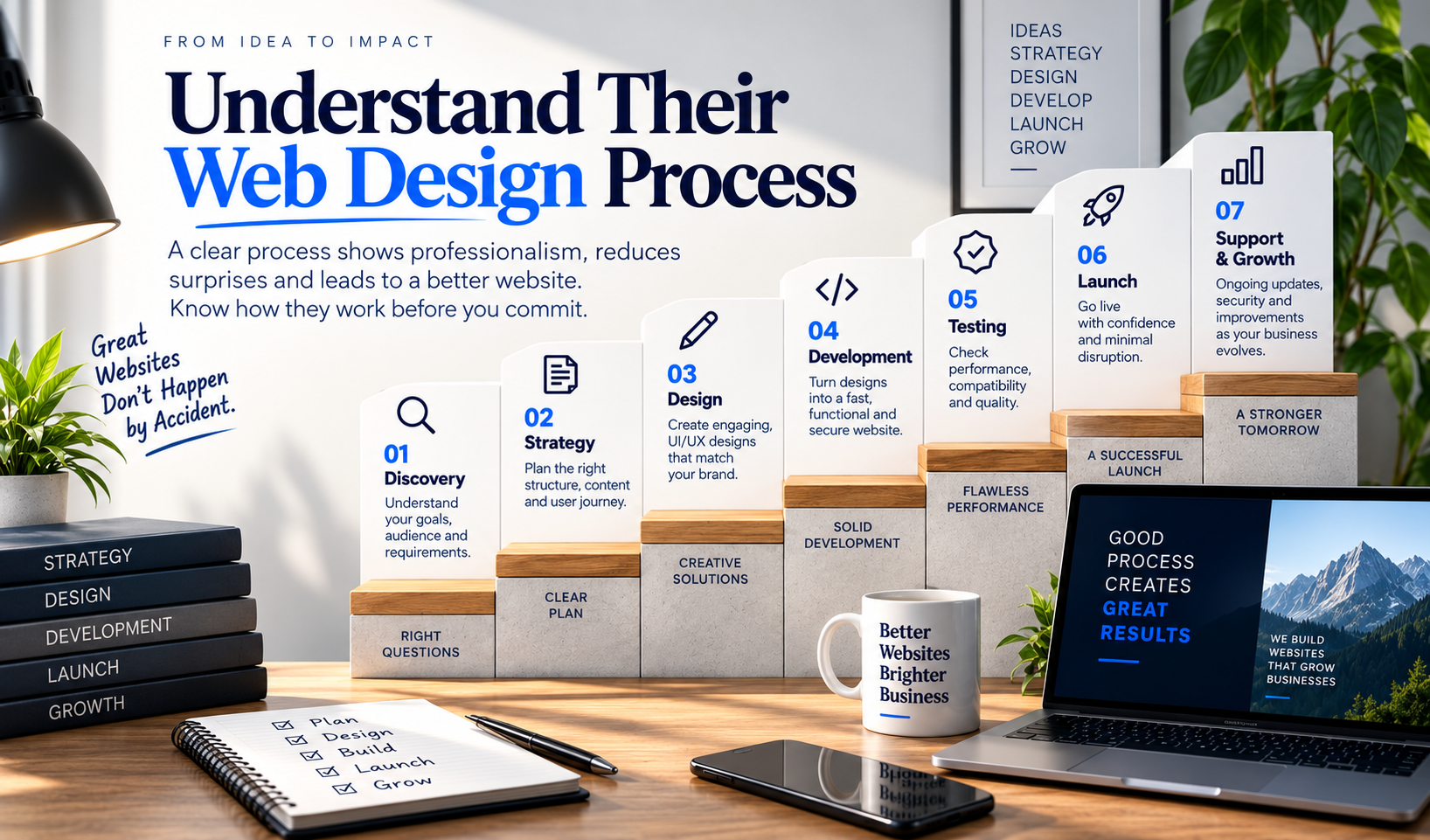
Unpack audience personas, competitive advantages, tech requirements, and project KPIs.
Plan sitemap hierarchy, URL architecture, and conversion paths before opening design software.
Craft low-fidelity layout blueprints followed by high-fidelity design systems and responsive screens.
Code the approved designs into responsive, secure, lightning-fast semantic HTML, CSS, and JavaScript.
Audit cross-browser rendering, Core Web Vitals, form delivery, analytics, and 301 redirects.
Execute DNS propagation, SSL deployment, sitemap submission, and Search Console verification.
Continuous security updates, conversion rate optimization, and ongoing technical maintenance.
7. 5. Find Out Who Will Actually Work on Your Project
Sales pitches are frequently delivered by senior partners or charismatic account executives. But who is writing your code and designing your checkout flow?
Key Inquiries for Your Discovery Call:
- • Will our project be executed in-house or outsourced to unvetted third-party contractors?
- • Who is our dedicated single point of contact (e.g., Technical Project Manager)?
- • Can we speak directly with the lead UI designer or lead full-stack engineer during milestones?
8. 6. Ask About Development Capabilities
Design and development are distinct engineering disciplines. An agency might produce stunning Figma mockups but struggle to implement clean Next.js code, robust database models, or complex CRM webhooks. Learn more in our breakdown of What Web Developers Do: Roles, Responsibilities, and Technical Systems.
Ensure the agency demonstrates verified production mastery in your target technology stack — whether that is custom React / Next.js, headless CMS, Shopify Plus, or enterprise WordPress through dedicated Web Development Services.
9. 7. Make Sure They Understand SEO
A website redesign and technical SEO cannot be separated. If your existing website generates organic traffic, a design agency that ignores SEO can destroy years of accumulated search authority overnight.
The Redesign Traffic Disaster Scenario:
An agency launches a visually gorgeous website but alters all URL permalinks, fails to implement 301 redirect mappings, deletes ranking blog content, and forgets canonical headers. Google encounters broken 404 links, and organic leads plummet by 70%.
A competent web agency conducts a thorough URL inventory, redirects all legacy pages, preserves metadata, configures XML sitemaps, and validates Google Search Console post-launch. Read our complete guide on How to Redesign a Website Without Losing SEO, or request a diagnostic SEO Audit before touching live URLs.
10. 8. Evaluate Mobile Responsiveness & Accessibility
Over 60% of all web traffic originates from mobile devices. Responsive design means tailoring layout hierarchy, button tap targets (minimum 48x48px), and typography specifically for touch interactions.
Similarly, digital accessibility (WCAG 2.1 compliance, color contrast ratios, keyboard tab navigation, and ARIA labels) protects your business from legal exposure and broadens market reach.
11. 9. Ask About Website Performance
Page speed directly influences search rankings and conversion rates. An agency must treat speed as an architectural foundation rather than a launch-day plugin patch:
Largest Contentful Paint (LCP)
Interaction to Next Paint (INP)
Cumulative Layout Shift (CLS)
Learn how Core Web Vitals directly sway user retention and Google search positions in our study: How Important Is Page Speed for SEO?.
12. 10. Understand Pricing and Scope
Never compare quotes based on dollar figures alone. An $8,000 quote that includes research, copywriting, custom development, SEO migration, and 90 days of post-launch warranty is vastly more economical than a $4,000 quote with eight critical exclusions that you must pay out-of-pocket later. For a complete comparison of project scopes and hourly vs. fixed pricing, see our guide on How Much Do Web Designers Charge? Practical Guide to Web Design Pricing.
13. 11. Find Out What Happens After Launch
Launch day is the start of your website's commercial lifecycle, not the end. Clarify warranty periods:
- • Bug-Fix Warranty: How many days of complimentary post-launch bug fixes are covered?
- • Software Updates: Who manages core CMS updates, security patches, and cloud database backups?
- • Iterative Growth: Does the agency offer ongoing retainers for new landing pages and conversion optimization?
14. 12. Evaluate Communication & Project Management
You don't need daily meetings; you need predictable, documented communication. Ask what project management software they use (Asana, ClickUp, Notion, Slack), how design reviews are conducted (Figma links, Loom walkthroughs), and who approves scope milestones.
15. Questions to Ask a Web Design Agency
Use this tactical discovery scorecard to evaluate prospective agencies:
| Key Discovery Question | What You Are Actually Evaluating |
|---|---|
| How would you approach our specific project? | Strategic thinking & custom problem-solving. |
| What primary issues do you see with our current website? | Preparation, honest insight & technical acumen. |
| Who will actually design and engineer the site? | Delivery team composition vs. sales rep handoff. |
| Is the design 100% bespoke or built on a pre-made theme? | True custom strategy vs. disguised template tweaks. |
| How do you conduct UX research & wireframing? | User-centered engineering vs. aesthetic guesswork. |
| How do you protect existing organic search rankings? | SEO migration protocols, redirects & schema. |
| What CMS or framework do you recommend and why? | Technical judgment matched to business needs. |
| How do you test across mobile devices and browsers? | Quality assurance rigor and responsive precision. |
| What is your revision process and feedback policy? | Scope control, transparency & collaborative rhythm. |
| What expenses or licenses are excluded from this quote? | Pricing transparency and hidden operating fees. |
| Who retains full intellectual property upon completion? | Asset ownership (code, designs, content, accounts). |
| What warranty or support is provided post-launch? | Long-term partnership commitment vs. launch-and-leave. |
16. Red Flags When Choosing a Web Design Agency
Guaranteed Commercial Results Without Discovery
Any agency promising 'we will 3x your revenue in 60 days' before inspecting your analytics, sales cycle, and product offer is fabricating certainty.
Every Portfolio Project Looks Identical
When a law firm, dental office, and crypto startup all share the exact same card grid, fonts, and hero layouts, you are buying a recycled template.
No Documented Development Process
If their explanation is simply 'pay the deposit and our designers will make something pretty,' you face severe scope drift and blown launch dates.
Ignoring SEO and URL Migration
Overhauling a revenue-generating website without 301 redirect mapping and metadata transfer can cause catastrophic search traffic crashes.
Focusing Exclusively on Aesthetic Decorations
If every conversation is about parallax scrolls and colors while nobody asks about your customer acquisition model, priorities are reversed.
Refusing Full Asset & Code Ownership
Never enter an agreement where the agency holds your domain, CMS accounts, source code, or Figma designs hostage upon project completion.
17. Freelancer vs. Web Design Agency
A solo freelancer is ideal when you have an existing design system, small scope, and can manage project operations internally. Learn more about what individual designers focus on in What Is a Web Designer & What Do They Actually Do?. An agency is essential when your commercial growth depends on multidisciplinary coordination across UX, UI, copywriting, engineering, technical SEO, and QA through full-service Web Design Services.
18. Local vs. Remote Agency
Physical location matters if you require on-site photography or in-person boardroom workshops. Otherwise, modern collaboration tools (Figma, Slack, Zoom, Loom, Staging URLs) make capability and communication far more critical than geographical proximity.
19. How Much Should You Pay a Web Design Agency?
Determine your budget by calculating the lifetime commercial value of the customers the website will attract. A high-end legal firm or medical practice where a single client is worth $15,000 can easily justify a $20,000 web design investment, whereas a local hobby club needs only a simple brochure setup. Explore our transparent Service Packages or Contact Our Strategic Team for a tailored scope estimate.
20. Web Design Agency FAQs
Common questions answered regarding hiring the right digital partner.
Don't Choose the Agency That Simply Makes the Best First Impression.
At AutoByte Solution, we build digital experiences where strategic branding, user psychology, full-stack performance, and search engine dominance work together. Schedule an exploratory discovery call to review your current website and growth roadmap.