What Is an SEO Audit? A Practical Guide to Finding What’s Holding Your Website Back
Learn what an SEO audit is, what it includes, how the audit process works, which problems it can uncover, and what your business should do next.
AutoByte SEO Lab
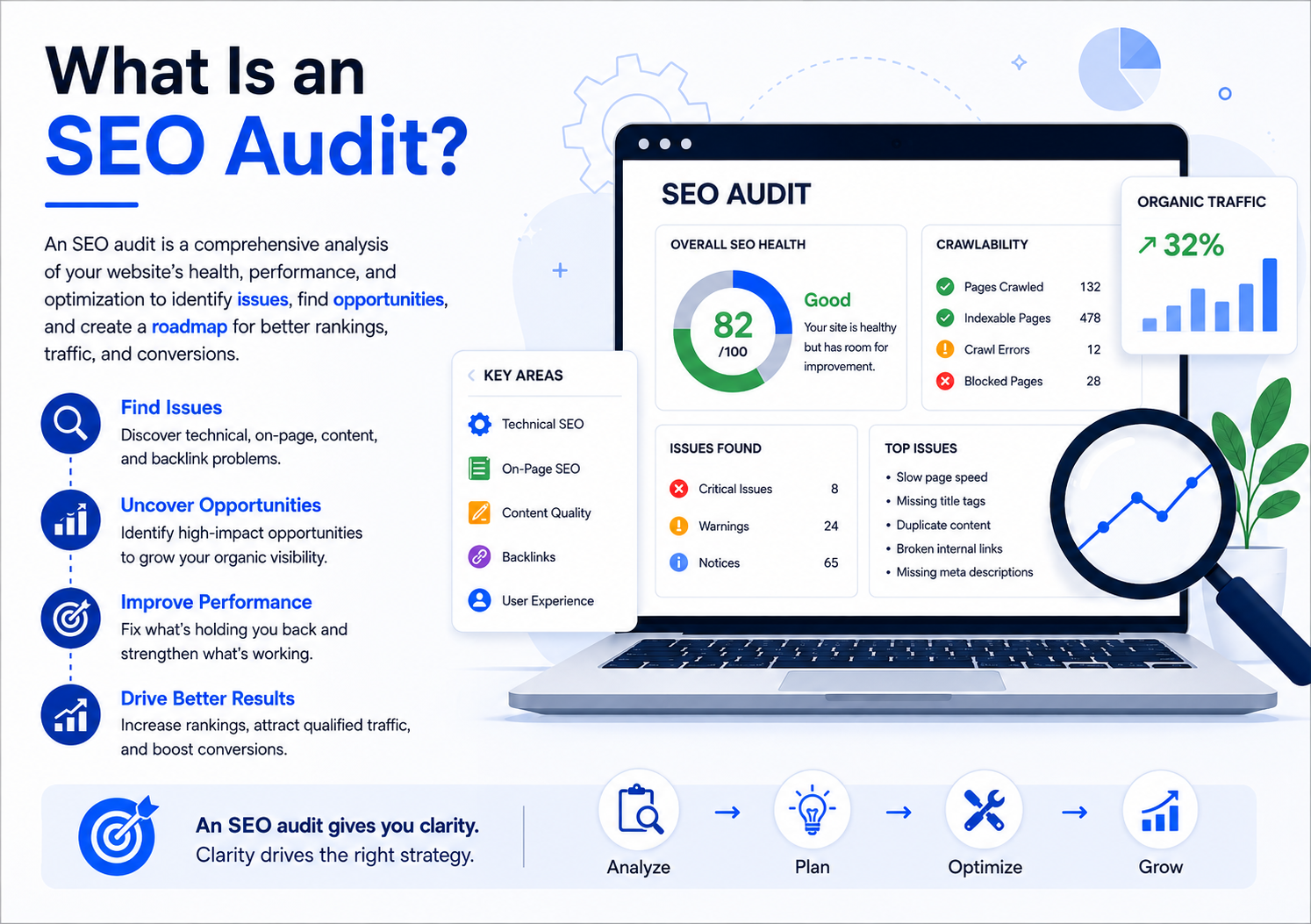
A website can look perfectly healthy and still have serious SEO problems underneath. Pages may load quickly. Content may be published regularly. The website may even rank for hundreds of keywords.
Yet critical revenue pages could be missing from Google's index. Internal links may be sending authority to low-margin tags. Multiple pages could be cannibalizing each other for the same intent. Valuable backlinks may point to broken 404 URLs. Or organic traffic may be growing without producing a single qualified lead.
You cannot fix those problems effectively until you know they exist. That is the purpose of an SEO audit.
The Three Questions a Real SEO Audit Answers:
What Is an SEO Audit?
An SEO audit is a systematic evaluation of a website's search performance, technical health, content quality, on-page optimization, site architecture, backlinks, and other factors that affect its ability to earn organic visibility and commercial conversions.
A 20-page local plumbing website does not need the same audit as an eCommerce store with 80,000 product URLs. An audit must investigate the website's actual business context—not blindly force every site through a generic automated checklist.
Why Is an SEO Audit Important?
SEO problems are rarely visible on the surface. If a buy button breaks on your site, customers complain immediately. But if an accidental tag change sets your highest-margin service page to noindex, the page continues to look completely normal to visitors—while organic search traffic quietly plummets.
The Real Audit Equation:
For example, you might discover a service page ranking at position 9 for a lucrative search term. Optimizing that existing page with internal links and refreshed content is a 10x faster win than publishing 10 brand-new articles from scratch.
What Does an SEO Audit Include?
Most comprehensive audits evaluate twelve fundamental areas:
| Audit Area | What You Are Trying to Understand |
|---|---|
| Technical SEO | Can search engine bots efficiently access, render, and understand the site architecture? |
| Indexation & Crawl Health | Are your high-value commercial pages indexed, or are orphan URLs consuming crawl budget? |
| On-Page SEO Optimization | Are individual landing pages targeted to satisfying specific user search intent? |
| Content Completeness | Does the website provide comprehensive, trustworthy information that beats competitors? |
| Website Architecture | Is domain hierarchy organized intuitively so authority flows to key revenue drivers? |
| Internal Linking Network | Are priority service pages supported by relevant contextual internal anchors? |
| Backlink Authority Profile | What external domains link to you, and are high-value referring links hitting 404 errors? |
| Page Speed & Core Web Vitals | Are high LCP, CLS, or INP latencies creating user bounce friction? |
| Competitor SERP Moats | Where are rivals outperforming you in keyword coverage, backlinks, and content depth? |
| Local SEO & Map Pack | Is the company visible for local high-intent geo queries and map pack rankings? |
| Analytics & Tracking Rigor | Are conversions, form fills, calls, and goal funnels tracked accurately? |
| Conversion Flow & CRO | Is organic traffic converting into real qualified leads and commercial revenue? |
The SEO Audit Process
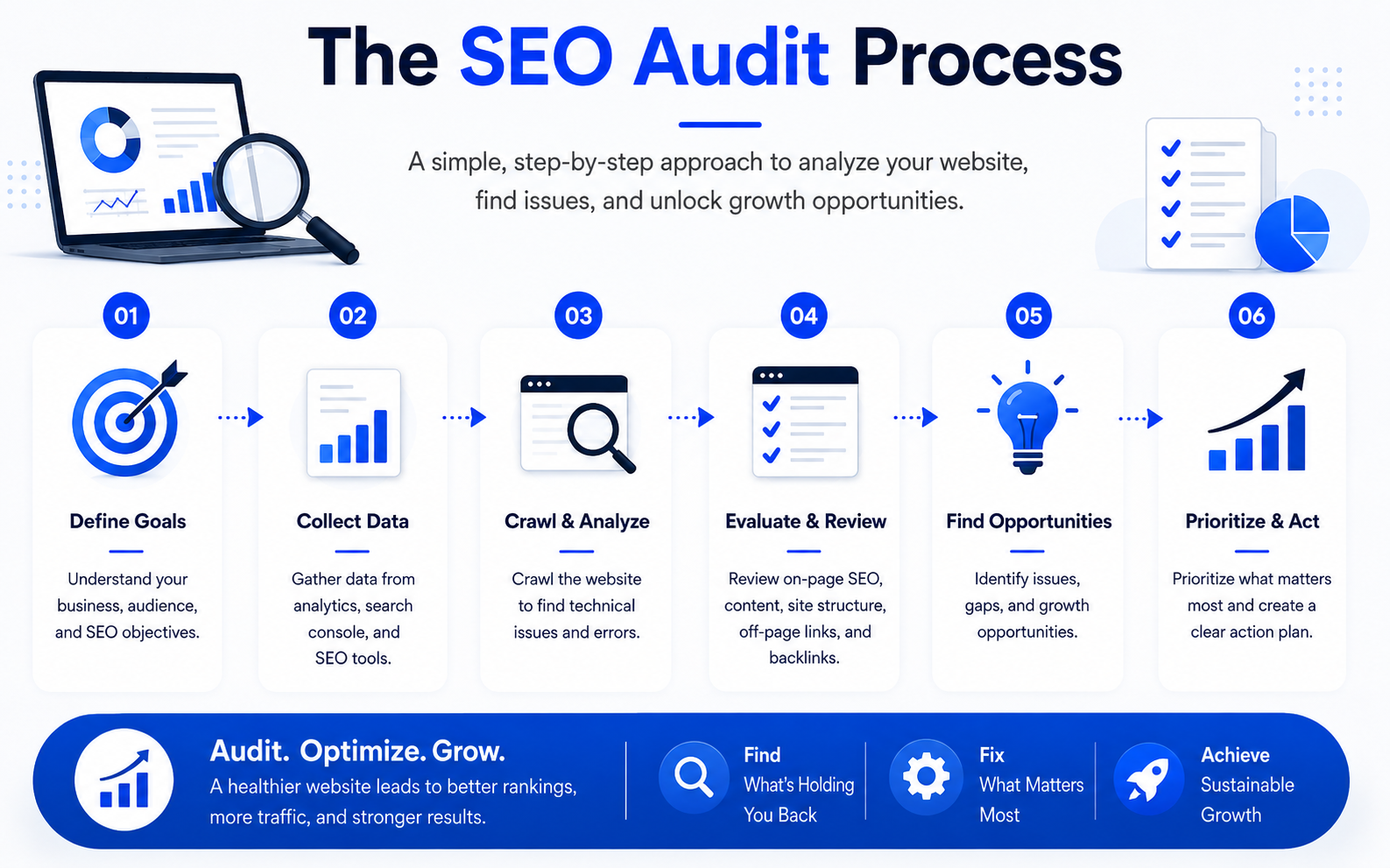
01. Define Goals
Start with the business, revenue drivers, ideal clients, and competitive landscape.
02. Collect Data
Gather first-party data from Google Search Console, GA4, server logs, and crawlers.
03. Crawl & Analyze
Run automated bots to expose broken status codes, redirect loops, and indexing blocks.
04. Evaluate & Review
Review on-page intent, content thinness, site hierarchy, and backlink health.
05. Find Opportunities
Identify low-hanging fruit keywords, competitor gaps, and internal linking leverage.
06. Prioritize & Act
Filter hundreds of crawler warnings down to the high-impact fixes that actually move revenue.
Technical SEO Audit
Search engines need to discover, render, and understand your pages before they can rank them. A technical audit examines:
Crawlability
Can Googlebot freely access key URLs without hitting robots.txt blocks?
Indexability
Are meta robots tags and HTTP headers allowing search engines to index pages?
XML Sitemaps
Are sitemaps clean, dynamic, and free of 404s or redirected URLs?
Canonicalization
Do rel=canonical tags point to authoritative URL versions to prevent dilution?
Redirect Health
Are 301 redirects direct, or are they chaining through multiple hops?
Structured Data
Is Schema.org JSON-LD valid and enriching SERP snippets with rich features?
Mobile Usability
Does the mobile viewport load cleanly without layout shifts or unclickable buttons?
Core Web Vitals
Do pages pass LCP, CLS, and INP thresholds on actual real-user mobile devices?
On-Page SEO Audit
Technical cleanliness doesn't automatically make a page relevant. Consider this classic mistake:
Poor On-Page Optimization
Title: Home | ABC Cleaning
H1: Welcome to Our Website
Search engines have zero clue what services are offered or what geographic areas are served.
Intent-Aligned Optimization
Title: Commercial Cleaning Services in Chicago | ABC Cleaning
H1: Reliable Commercial & Office Cleaning Services in Chicago
Immediately communicates topic, location, and satisfies high-intent commercial searchers.
Content Audit: The 6 Strategic Actions
Publishing more content is rarely the answer to poor SEO. For every existing page, an audit assigns one of six strategic actions:
Keep
Page is performing well and driving conversions; leave intact.
Improve
Valuable topic with low rankings; refresh content and add internal links.
Consolidate
Multiple overlapping articles; merge into one definitive authoritative guide.
Redirect
Obsolete URL that should 301 redirect to a relevant modern parent page.
Remove
Zero-traffic thin content that adds no value; prune to save crawl budget.
Create
Identified high-intent search query that has no dedicated landing page on the site.
Website Architecture & Internal Linking Audit
If a high-value service page requires six clicks to reach:Home → Services → Category → Subcategory → More Services → Service Page
that page is effectively buried. A clear, shallow click-depth architecture ensures link equity flows directly to your revenue drivers:
├── SEO Services (Technical SEO, Local SEO, eCommerce SEO, SEO Consulting)
├── Web Design & UI/UX Architecture
├── Custom Software & Next.js Development
└── Performance Digital Marketing & PPC
Backlink Audit & Authority Recovery
The single fastest quick win in an SEO audit is finding high-authority backlinks pointing to deleted 404 pages. If 40 external sites link to example.com/old-service, redirecting that URL to your updated active page immediately recaptures domain authority that was completely wasted.
Local SEO Audit
For geo-dependent businesses, the audit inspects Google Business Profile categories, NAP (Name, Address, Phone) consistency across directories, customer review response velocity, local citations, and localized landing pages.
Competitor Analysis During an SEO Audit
You don't compete in a vacuum. An audit benchmarks your domain against top-ranking rivals to uncover keyword gaps, content depth discrepancies, backlink sources, and UX expectations that Google reward in your sector.
Common SEO Problems an Audit Can Uncover
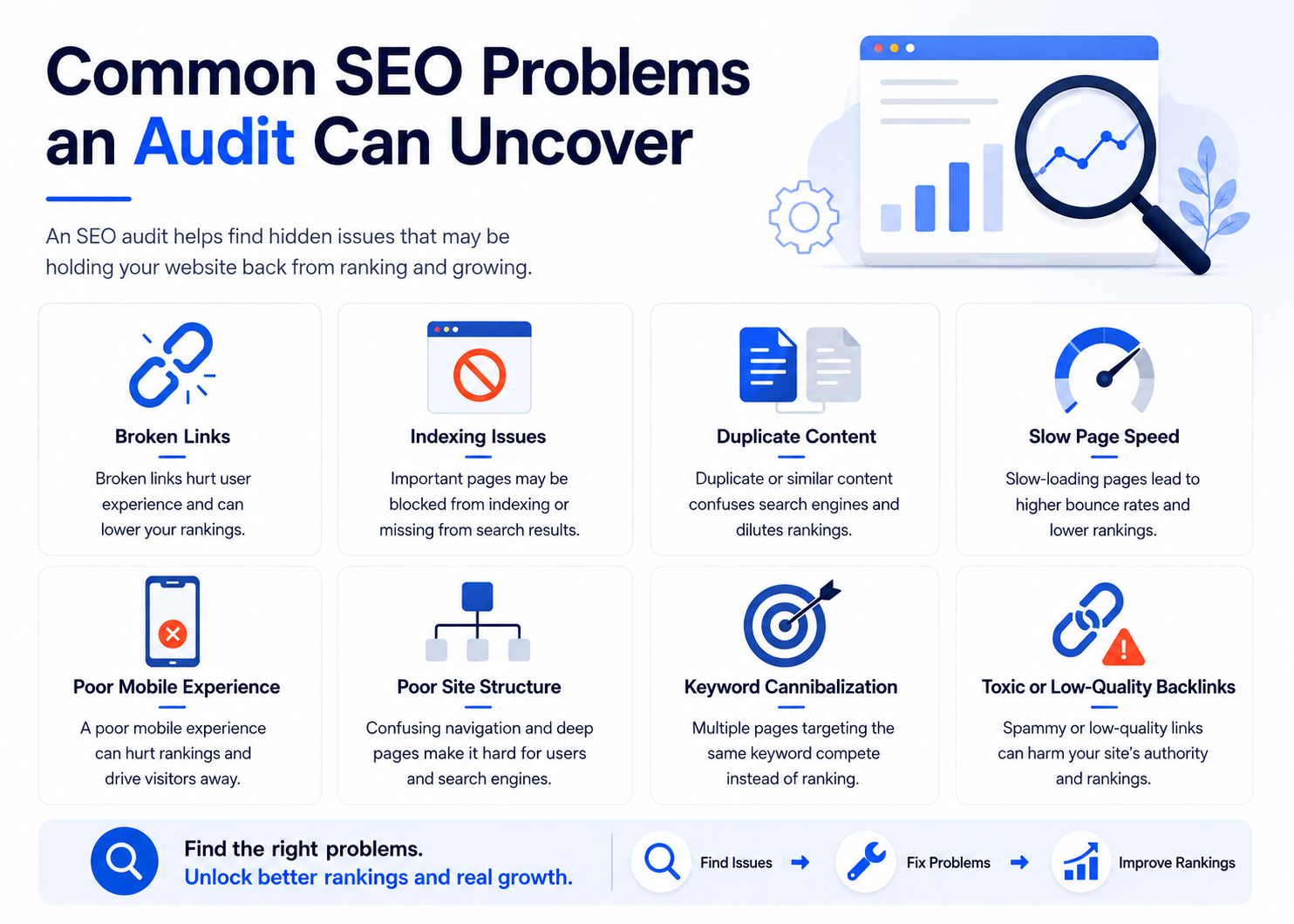
Broken Links (404s)
Broken links degrade user experience and leak search engine crawl budget.
Indexing Issues
Important revenue pages are accidentally blocked from indexing by rogue robots tags.
Duplicate Content
Multiple URLs serve identical content, confusing crawlers and diluting page authority.
Slow Page Speed
Heavy unoptimized images and bloated scripts drive bounce rates up and rankings down.
Poor Mobile UX
Non-responsive elements frustrate smartphone users who make up over 60% of search traffic.
Poor Site Structure
Buried navigation makes it difficult for search bots and humans to discover services.
Keyword Cannibalization
Multiple pages on your site compete against each other for the exact same query.
Toxic Backlinks
Spammy low-quality links threaten your domain authority and risk manual penalties.
Prioritizing Issues: Not Every Warning Deserves Attention
Automated audit tools regularly produce 400+ warnings. That does not mean you have 400 equally important crises. A professional audit evaluates every finding through a structured impact model:
| Evaluation Factor | The Strategic Question |
|---|---|
| Impact | How much could fixing this issue directly improve rankings, indexing, or traffic? |
| Reach | How many critical landing pages or high-traffic URLs are affected by this problem? |
| Effort | How complex and resource-intensive is the technical or editorial implementation? |
| Confidence | How confident are we that this diagnosis represents the true performance bottleneck? |
| Business Value | Does this fix directly protect or grow high-margin service revenue? |
The Issue A vs. Issue B Comparison:
Issue A: 200 Missing Image Alt Tags
Impact: Very Low. Does not prevent pages from ranking.
Issue B: Primary Service Category Has Noindex Tag
Impact: Critical. Completely wipes out organic revenue visibility.
What SEO Audit Tools Are Used?
Search Console & Analytics
Google Search Console & GA4 for verified first-party clicks, impressions, and conversions.
Technical Crawlers
Screaming Frog SEO Spider & Sitebulb for auditing status codes, redirects, and rendering.
Competitive Databases
Ahrefs & Semrush for domain backlink profiles, SERP keyword gaps, and competitor estimates.
How Long Does an SEO Audit Take?
A small business site with 20 pages can be audited thoroughly in 3 to 5 business days. A massive eCommerce store with 50,000 SKUs, international hreflang tags, or complex JavaScript rendering may require 2 to 4 weeks of forensic engineering.
How Often Should You Perform an SEO Audit?
A comprehensive audit should occur annually or during key milestones: before a redesign, immediately following a CMS migration, after sudden unexplainable traffic drops, or when organic growth hits a multi-month plateau.
SEO Audit vs. SEO Strategy: What's the Difference?
The Continuous Growth Flywheel
What Should Happen After an SEO Audit?
Never let an audit sit as an ignored PDF in someone's email. Convert the findings into a phased execution roadmap:
Phase 1: Critical Fixes
Eliminate crawl blocks, broken 404s, indexation errors, and canonical loops.
Phase 2: High-Value Quick Wins
Optimize pages already sitting in positions 8 to 15 with intent-focused copy.
Phase 3: Architecture & Internal Links
Restructure navigation so link equity flows directly to primary service offerings.
Phase 4: Content Topic Clusters
Fill competitive content gaps and create supporting educational hub pages.
Final Thoughts: A Good SEO Audit Tells You What to Do Next
At AutoByte Solution, we treat an SEO audit as a forensic investigation rather than a generic tool printout. Technical health, search intent, site architecture, backlinks, and conversion rates must be examined together. Finding 500 minor warnings isn't impressive. Finding the five hidden issues that are actually suffocating your revenue—and engineering the solution—is where real growth begins.
Because an SEO audit shouldn't give you more homework. It should give you clarity and an actionable growth roadmap.
AutoByte SEO Lab
Technical Search Architecture & Crawl Engineering
AutoByte Solution conducts forensic technical SEO audits, architecture restructuring, and growth diagnostics that turn crawl data into revenue.