How Does SEO Work on AI Mode? A Practical Guide to Ranking in Google’s AI Search
Learn how SEO works on Google AI Mode, how query fan-out changes search, what content AI Search can surface, and how to optimize your website for AI visibility.
AutoByte AI & Search Intelligence Lab
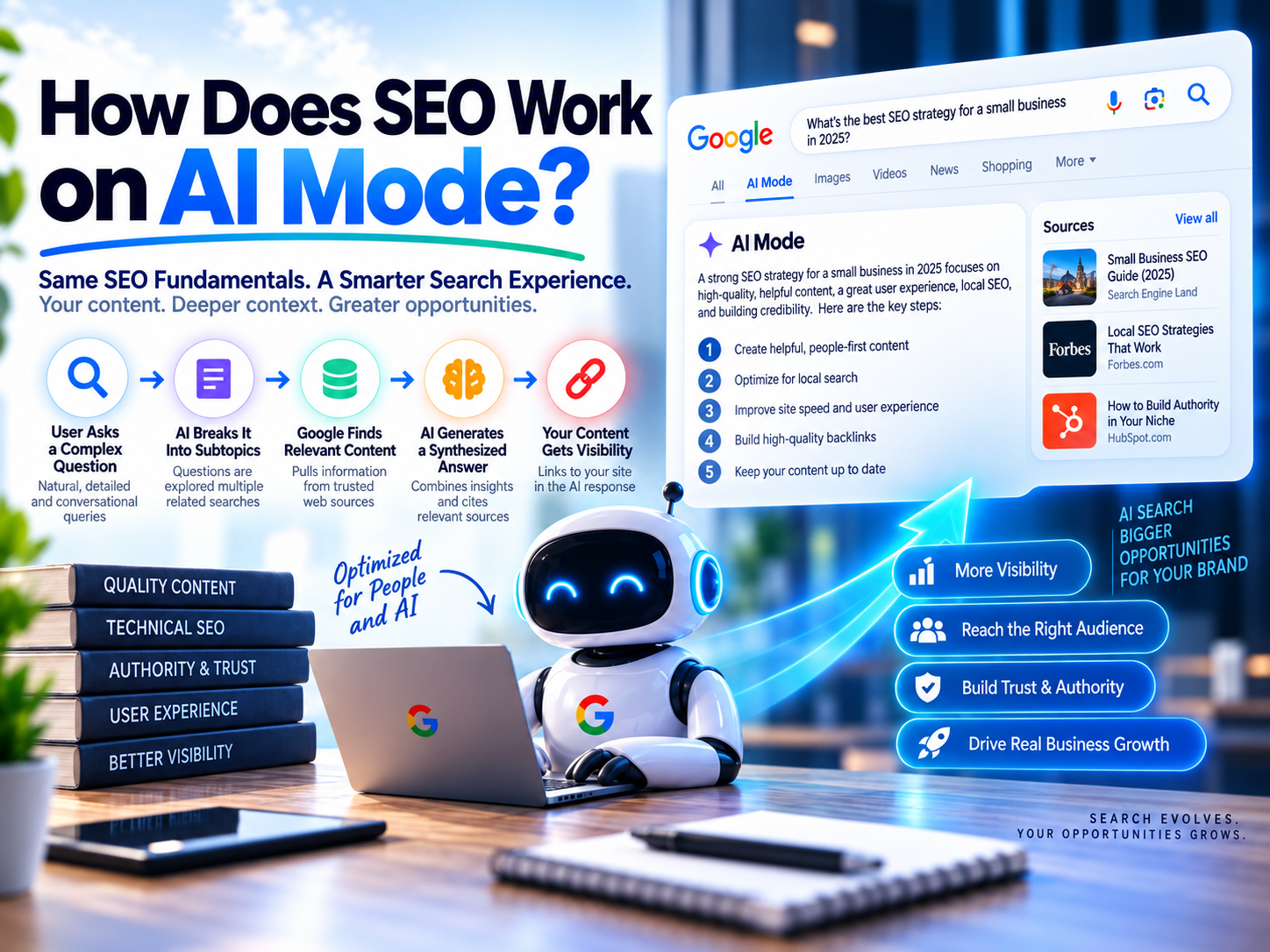
For years, SEO followed a fairly predictable, mechanical rhythm.
Someone typed: "best SEO company for small business". Google served a list of ten blue links. Agencies competed for top positions. Users clicked the first organic result.
Google’s AI Mode fundamentally changes that user journey.
Today, a prospective buyer can search something far more nuanced and contextual:
Instead of matching a rigid keyword string, Google's AI Mode decomposes that question into multiple sub-inquiries, pulls authoritative content from diverse sources across the web, reasons across what it discovers, and produces a synthesized answer citing relevant supporting websites.
Google calls this technological breakthrough query fan-out.
At first glance, that sounds like SEO has died. It hasn't. But the architecture of search discovery has transformed forever.
The Fundamental Truth of AI Mode SEO:
SEO for Google AI Mode begins with traditional search fundamentals: crawlability, indexation, useful content, relevance, authority, internal linking, and a high-performance page experience. Google explicitly affirms there are no proprietary technical tricks or secret AI markup needed to appear in AI Mode. What changes is the scope: instead of targeting a single isolated keyword, your website must provide deep, original answers to the complex subtopics, comparisons, and commercial decisions AI Search explores.
1. What Is Google AI Mode?
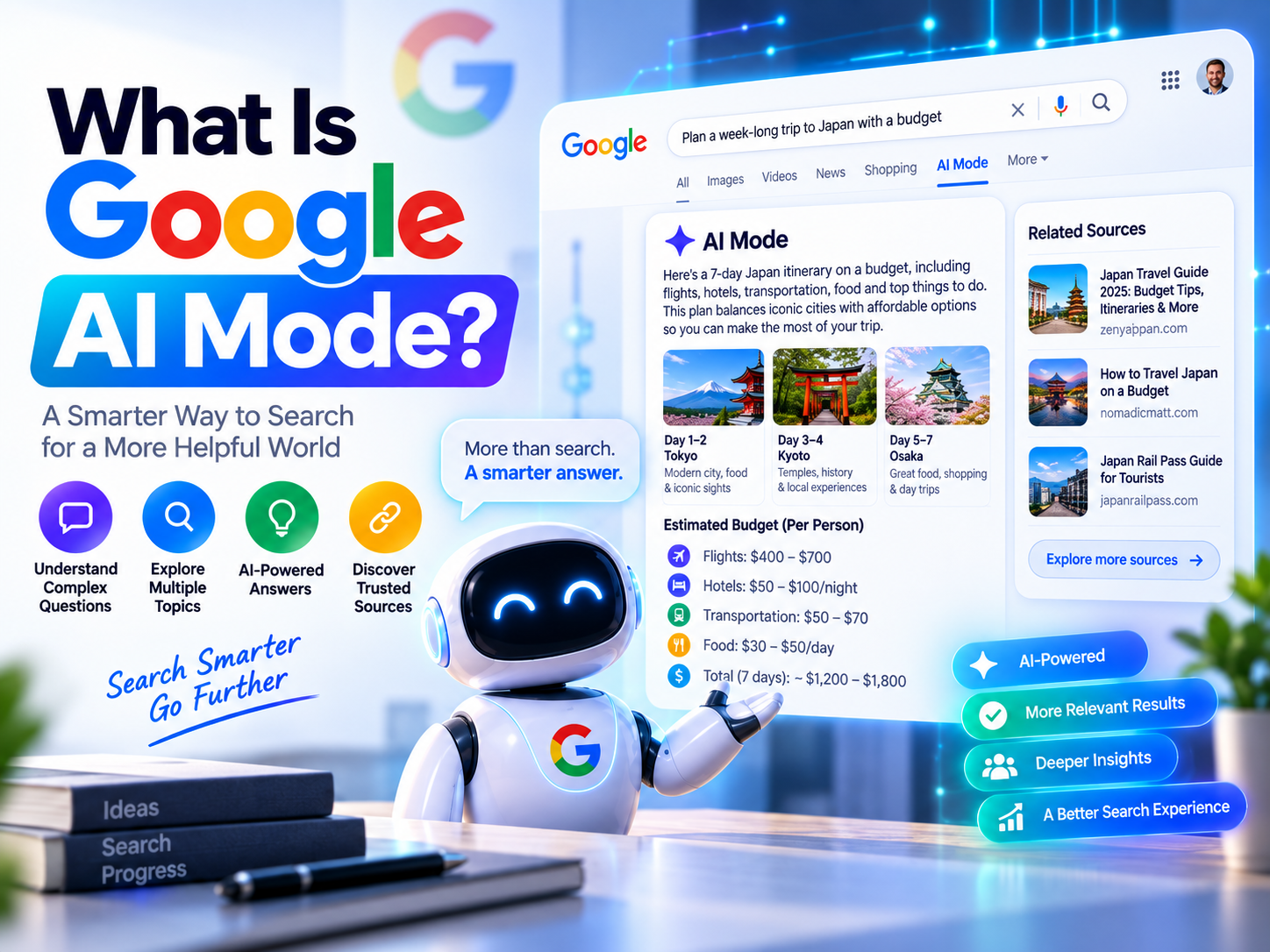
Google AI Mode is an AI-powered conversational search experience built to handle multi-layered inquiries, comparison matrices, follow-up explorations, multimodal queries, and research requiring genuine reasoning.
Rather than just listing traditional page links, AI Mode generates an intelligent synthesis while embedding direct citations and link cards that allow searchers to explore supporting websites.
As of 2026, Google confirms AI Mode has surpassed one billion monthly active users globally, with query volume doubling every quarter since its rollout.
The Evolution of Query Complexity:
"best CRM software"
Single dimension, vague search intent, requires user to browse 5 different vendor comparison sites.
"I run a 12-person agency and need a CRM that integrates with Gmail, automates follow-ups, costs under $100/mo, and requires no developer."
8 distinct parameters: company size, industry, integration, feature, budget, technical constraint, and comparison intent.
2. How Does SEO Work on AI Mode?
To master SEO in this new paradigm, compare how search execution flows in traditional search versus AI Mode:
- 1. User types targeted keyword
- 2. Google queries static inverted index
- 3. Algorithmic ranking scores pages
- 4. User selects from list of blue links
- 1. User asks complex, conversational problem
- 2. AI breaks question into subtopics (query fan-out)
- 3. Retrieval-Augmented Generation pulls current index pages
- 4. AI reasons across data & synthesizes response
- 5. Supporting websites are cited & displayed as link cards
This shifts the business objective. The question is no longer just: "Can my page rank #1 for an exact-match phrase?" It is also: "Does our site provide information authoritative enough to be selected as a cited source within the AI answer?"
3. How Query Fan-Out Changes SEO
Query fan-out is the foundational engine of Google AI Mode. Consider a practical scenario:
Under the hood, Google's AI system fans out into multiple specialized investigative subtopics:
Similarly, when someone asks: “Should I redesign my website before investing in SEO?”, the search encompasses:
- •Can a website redesign hurt existing SEO rankings?
- •How does web design and page speed affect conversion rates?
- •How should 301 URL redirect mapping be handled pre-launch?
- •Should SEO strategy be established before or after UI/UX design?
4. Is Traditional SEO Still Important for AI Mode?
Yes — unconditionally.
One of the biggest misconceptions circulating today is that generative search renders traditional SEO obsolete. Google's official 2026 documentation specifically refutes this:
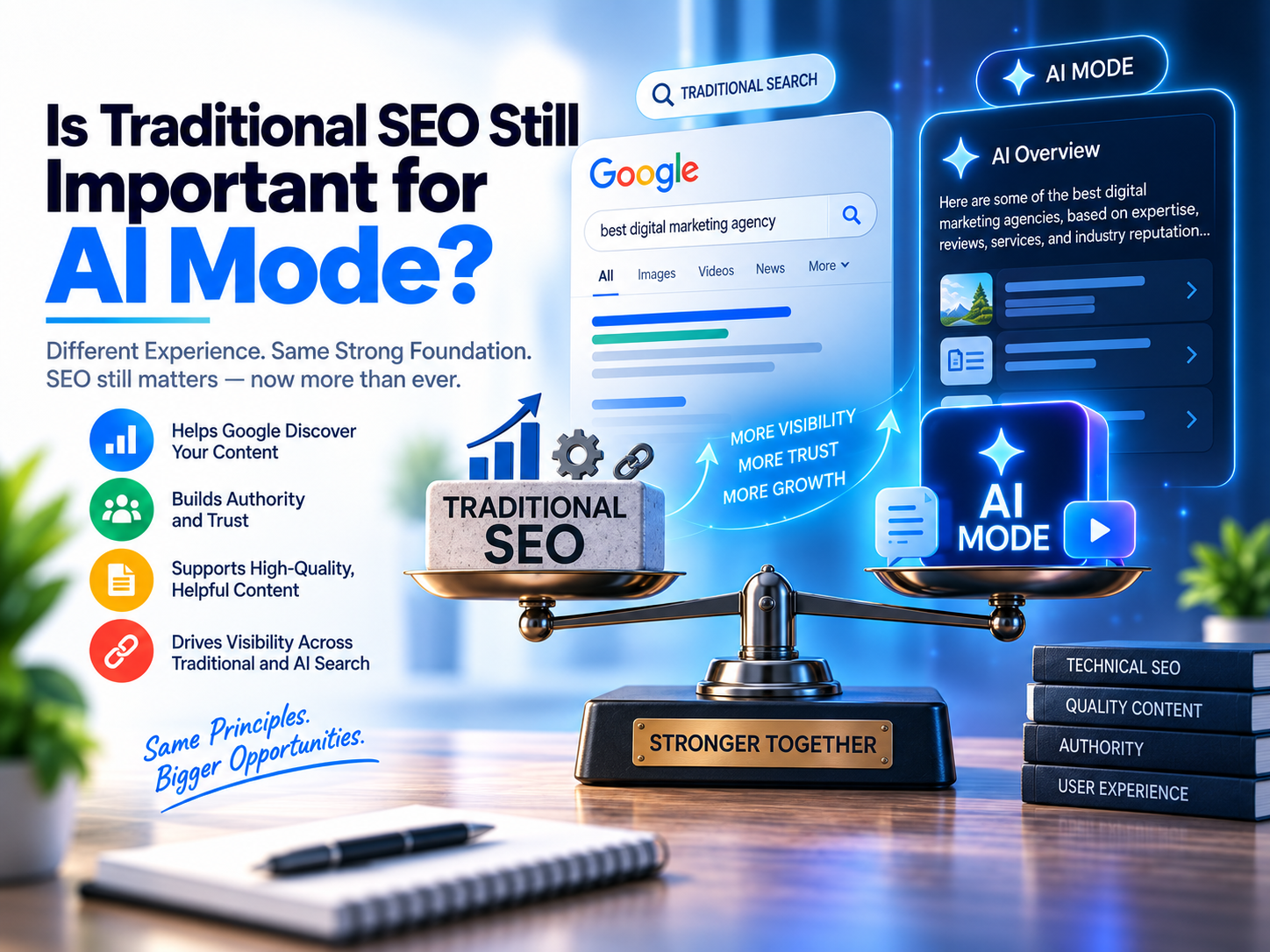
The Non-Negotiable SEO Pillars AI Search Depends On:
5. What Type of Content Performs Well in AI Mode?
AI systems can already summarize dictionary definitions instantly. If your article merely recycles generic advice like: "SEO stands for search engine optimization and helps your website get traffic", an AI model has zero incentive to cite you.
Google specifically prioritizes non-commodity, proprietary information:
1. Firsthand Practical Experience
Instead of stating "website migrations are complex", explain the exact pre-launch URL mapping protocols, redirect validation scripts, and Search Console delta benchmarks used by your team.
2. Proprietary Data & Original Research
Publish customer survey data, internal conversion rate benchmarks, A/B test logs, and pricing datasets that cannot be hallucinated or scraped elsewhere.
3. Detailed Case Studies (Problem → Solution → Numbers)
Real commercial proof with specific metrics. AI models prize structured case studies when answering feasibility and ROI queries.
4. Nuanced Comparison Frameworks
Clear tables breaking down Option A vs Option B with concrete trade-offs, pricing ranges, and ideal use cases.
6. Does E-E-A-T Matter for AI Search?
E-E-A-T (Experience, Expertise, Authoritativeness, and Trustworthiness) is not a single numeric score or algorithmic switch. It is a framework for giving both human readers and search models justifiable reasons to trust your claims.
Tangible E-E-A-T Signals That AI Models Verify:
7. How Keywords Work Differently in AI Mode
Keywords are not dead, but optimizing exclusively for a single isolated phrase with 1,000 monthly searches is dangerously shortsighted.
Consider a long-tail business query:
A traditional keyword tool like Ahrefs or Semrush will show 0 Monthly Search Volume for that exact sentence. Yet that query represents a high-value prospective buyer. AI Mode unlocks this conversational long-tail traffic by recognizing the interconnected concepts.
8. Technical SEO for Google AI Mode
According to Google's technical engineers: a page must be indexed and eligible to display a snippet in standard Google Search to be eligible as a supporting link in AI Mode.
If your page suffers from canonical conflicts, noindex tags, render-blocking JavaScript, or crawler chokepoints, no amount of AI copywriting will surface it.
9. Do You Need Special Schema or an llms.txt File for Google AI Mode?
The Direct Answer: No.
Google has confirmed on multiple occasions that there is no proprietary AI schema.org markup required or recognized for AI Mode inclusion. Furthermore, Google’s 2026 guidance clarifies that webmasters do not need to construct markdown summary files like llms.txtto appear in Google's generative search features.
Continue implementing standard, verified schema: Organization, Article, Product, FAQPage, and BreadcrumbList to describe visible page elements accurately.
10. How to Optimize Content for AI Mode: The Topic Ecosystem Blueprint
Instead of building isolated, keyword-stuffed blog posts, high-growth websites construct interconnected Topic Clusters.
How Integrated Pillar & Cluster Internal Linking Drives AI Retrieval
Rather than relying on one catch-all landing page, our agency builds interconnected silos where service hubs are anchored by dedicated, high-intent guides:
When Google's AI queries fan-out across these subtopics, this interconnected architecture signals comprehensive domain authority, dramatically increasing citation frequency in AI Mode.
11. Can Blogs Still Generate Traffic From AI Search?
Yes. While simple factual queries can be answered directly on the SERP without a click, users researching complex high-consideration decisions click through to sources offering:
AI synthesizes the overview; your website must provide the depth that makes clicking the link indispensable.
12. How to Measure AI Mode SEO Performance
As of August 31, 2026, Google has rolled out dedicated Generative AI Search Performance Insights inside Google Search Console worldwide.
Key Metrics Tracked in Google Search Console:
- 1. Generative AI Impressions:How often your website appears as a cited card in AI Mode and AI Overviews.
- 2. Top Cited URLs:Which specific pages and guides are being selected as reference sources.
- 3. Geographic & Device Breakdown:Where and on what devices users are encountering your AI citations.
13. 6 Common Google AI Mode SEO Mistakes
Creating Scaled AI Commodity Content
Mass-publishing low-effort AI articles that merely restate generic Wikipedia definitions. Google's spam algorithms penalize scaled unoriginal content.
Abandoning Keyword Research Completely
Assuming conversational search eliminates keywords. Keywords still represent identifiable customer demand and real search volume.
Relying on Gimmicky llms.txt Files
Treating an llms.txt file as a shortcut for real SEO. Google confirms special AI text files are not necessary for ranking in AI Mode.
Manufacturing Fake Expertise (Faux E-E-A-T)
Slapping 'our experts tested' labels on unverified claims. Authentic experience requires real workflow benchmarks, data, and case studies.
Chaining Everything into Unnatural FAQs
Forcing every page into 50 fragmented question snippets. Format content around how human decision-makers read and evaluate solutions.
Neglecting Technical SEO & Crawlability
If Googlebot cannot access, parse, and render your pages with snippets, AI models cannot retrieve and cite your content.
14. What Does AI Mode Mean for the Future of SEO?
The repetitive claim that "SEO is dead" misses the reality: the unit of search is simply shifting from single keywords to holistic customer problems.
The Modern SEO Paradigm
At AutoByte Solution, we help companies engineer digital ecosystems that satisfy human decision-makers and AI retrieval pipelines simultaneously.
AutoByte AI & Search Intelligence Lab
Generative AI Search Engineering & Technical SEO
AutoByte Solution engineers search architectures, topical authority ecosystems, and semantic content models optimized for modern AI search engines, RAG pipelines, and conversion growth.