What Does a Digital Marketing Agency Do for Small Businesses?
Discover what a digital marketing agency does for small businesses, from SEO and paid ads to content, social media, websites, analytics, and growth strategy.
AutoByte Growth Lab
Running a small business means constantly deciding where your time, money, and attention should go. You may be managing customers, operations, employees, sales, finances, and growth at the same time. Marketing often becomes another responsibility added to an already long list.
That is where a digital marketing agency can help. But what does a digital marketing agency do for small businesses, exactly?
The Definition of Growth-Focused Marketing:
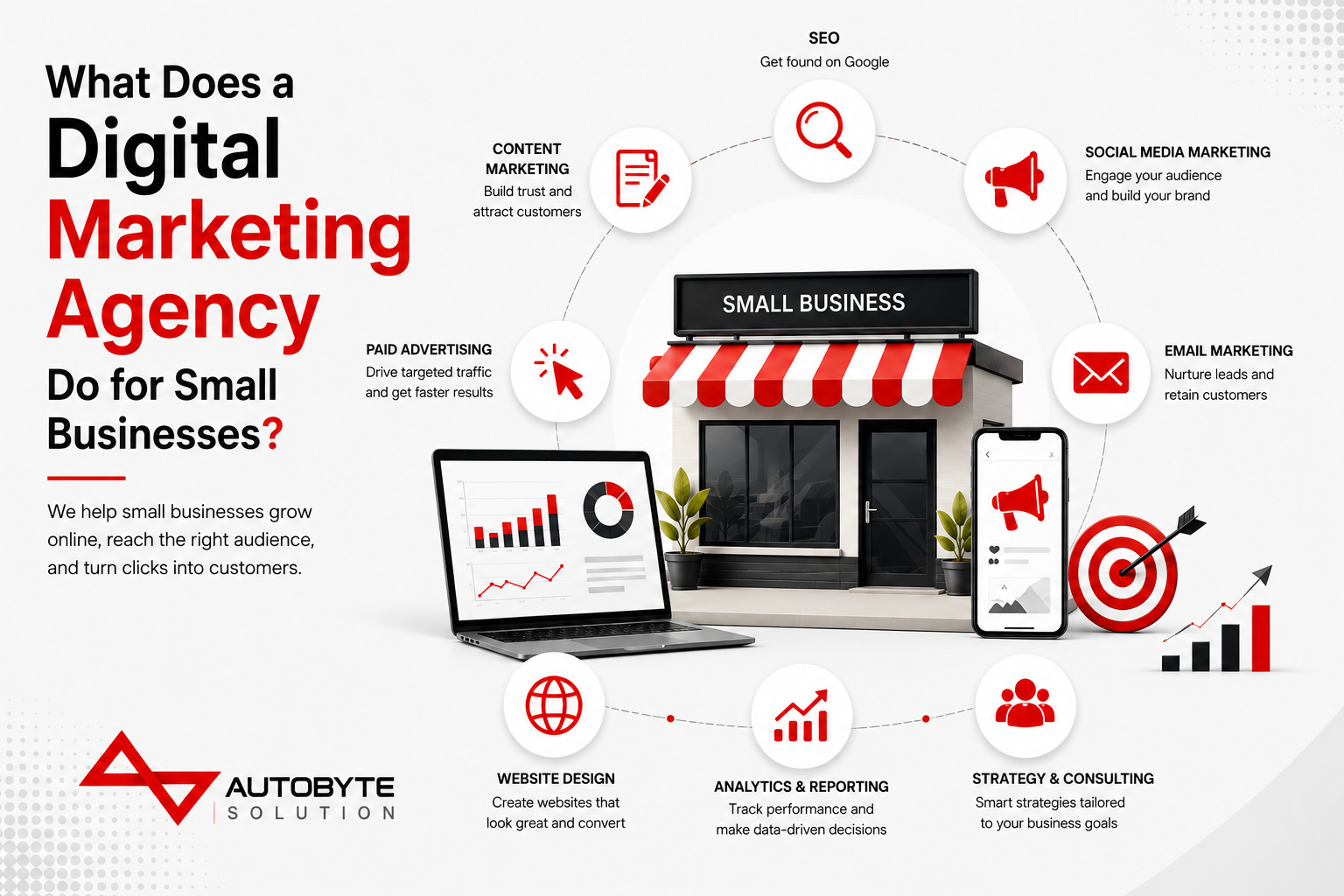
A digital marketing agency helps small businesses build their online presence, reach the right audience, generate leads or sales, and measure which marketing activities are actually contributing to growth. Depending on the business, this can include SEO, paid advertising, social media, content marketing, email marketing, website optimization, analytics, and overall digital strategy.
The important part isn't simply doing more marketing. It is identifying which channels make sense for your business and how they should work together.
What Is a Digital Marketing Agency?
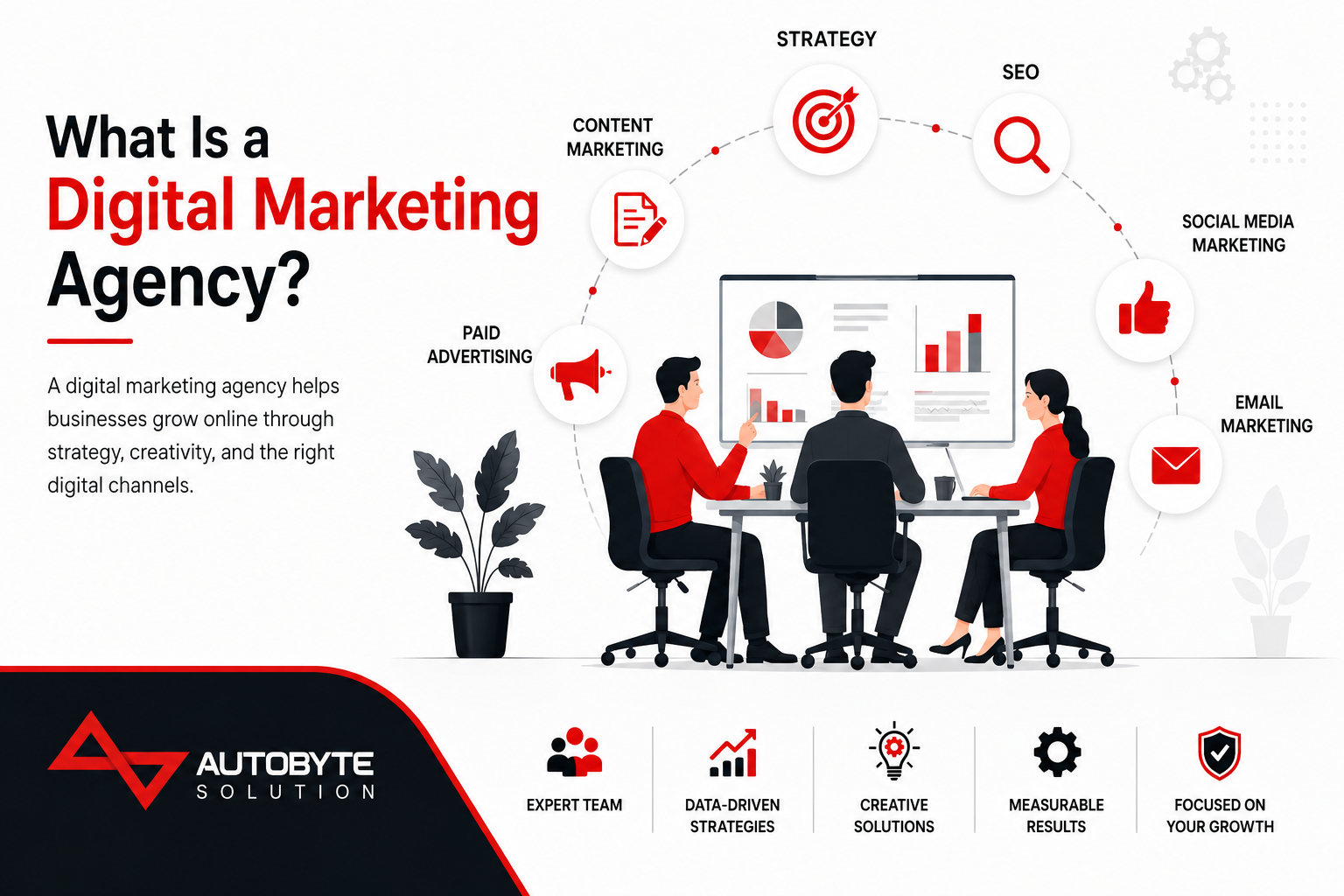
A digital marketing agency is a company that helps businesses promote their products or services through online channels. Depending on its capabilities, an agency may combine specialists across SEO, paid advertising, social media, content, design, web development, analytics, email marketing, and growth strategy.
For a small business, this provides immediate access to several senior marketing disciplines without having to build, hire, and manage an entire internal department.
What a Quality Agency Explores Before Recommending Services:
- • What your business sells & high-margin products
- • Who your ideal customers (ICP) truly are
- • Where you operate (Local, Regional, National)
- • What unique advantages set you apart from rivals
- • Which marketing channels you are already using
- • How customers currently find and evaluate you
- • What a qualified lead or sale is worth (LTV)
- • What specific revenue goals you want to achieve
What Does a Digital Marketing Agency Do for Small Businesses?
At its core, a digital marketing agency connects your business with potential customers online. A potential customer may first discover your company through Google, see your brand again on social media, visit your website, read your content, compare you with competitors, and finally submit an inquiry or make a purchase.
The Multi-Stage Growth Pipeline
1. Understands Your Business and Customers
Effective marketing services begin with understanding the customer rather than jumping straight into ad spend. An agency researches your target audience, customer problems, search intent, competitors, and value propositions before recommending campaigns.
2. Tailors Channel Selection to Business Models
Small businesses do not need to be on every platform. They need to be visible where their target buyers convert:
Local Service Business
Local SEO + Google Maps + Search Ads + Fast Call Landing Pages
Online Retailer
eCommerce SEO + Google Shopping + Paid Social + Cart Abandonment Flows
B2B Company
Technical SEO + Thought Leadership + LinkedIn Ads + Lead Nurturing
Why Small Businesses Hire Digital Marketing Agencies
Access to Multiple Skills
Gain instant access to SEO strategists, developers, designers, copywriters, and media buyers without individual hires.
More Time for Operations
Owners can focus on staff, customer service, operations, and sales while specialists drive pipeline growth.
Better Marketing Technology
Leverage enterprise-grade software (Ahrefs, Semrush, CallRail, heatmaps) without expensive individual licenses.
Objective Outside Perspective
An external team spots funnel bottlenecks and positioning blind spots that are hard to see from the inside.
Continuous Optimization
Digital campaigns aren't static. Ongoing testing, bid management, and CRO ensure ad dollars aren't wasted.
Predictable Scalability
Easily ramp up ad spend or expand into new channels as cash flow and capacity increase.
What Digital Marketing Services Do Small Businesses Need?
Search Engine Optimization (SEO)
Improves organic visibility for high-intent searches like "commercial cleaning services", "small business accountant", or "roofing company near me". Attracts qualified buyers actively searching for solutions.
Local SEO & Google Business Profile
Drives calls and store visits through map pack rankings, citation consistency, reviews management, and localized landing pages.
Pay-Per-Click Advertising (PPC)
Immediate targeted reach on Google Search, Shopping, and social networks. Managed for low Customer Acquisition Cost (CAC) rather than meaningless click volume.
Social Media Marketing & Retargeting
Builds brand awareness, stays top-of-mind with past website visitors, and demonstrates proof and community trust.
Content Marketing & Authority Guides
Answers buyer questions before they ever talk to sales. Guides, comparison articles, and videos move prospective clients through the buying funnel.
Website & Landing Page Optimization (CRO)
Traffic is worthless if pages don't convert. Ensuring fast load times (sub-1.5s), intuitive mobile navigation, clear value propositions, and frictionless booking forms.
Analytics & Closed-Loop Conversion Tracking
Tracks actual business milestones: calls, form submissions, appointments, and purchases, ensuring decisions are based on ROI instead of guesses.
How a Digital Marketing Agency Builds a Strategy
Step 1: Discovery
Deep-dive into business model, margins, customers, and competitor landscape.
Step 2: Comprehensive Audit
Assess website speed, SEO crawl health, existing ad efficiency, and conversion paths.
Step 3: Opportunity Analysis
Identify the highest-ROI, lowest-hanging fruit growth channels.
Step 4: Channel Selection
Pick the exact platforms where target buyers congregate and take action.
Step 5: Rapid Execution
Deploy landing pages, launch search campaigns, write content, and fix technical bugs.
Step 6: Real-Time Measurement
Monitor lead flow, phone calls, cost per acquisition, and closed sales.
Step 7: Continuous Optimization
Refine bids, A/B test headlines, expand keyword clusters, and scale budget.
Digital Marketing Agency vs In-House Marketing
Small businesses frequently wonder whether they should hire an agency or build an internal team:
| Factor | Digital Marketing Agency | In-House Team |
|---|---|---|
| Range of expertise | Access to multiple specialists (SEO, dev, ads, design) | Depends on team size (often generalists) |
| Business familiarity | Requires onboarding & discovery | Usually very high internal knowledge |
| Scalability | Often easier to expand or pivot quickly | Requires lengthy hiring & training cycles |
| Management | Agency manages specialists internally | Business owner manages employees directly |
| Communication | Structured external collaboration | Direct internal desk/chat access |
| Best fit | Businesses needing diverse, high-level capabilities | Businesses needing continuous dedicated daily execution |
A hybrid model is also common: an internal manager handles brand priorities while an agency executes technical SEO, web development, and paid search.
How Much Does Digital Marketing Cost for a Small Business?
Pricing depends on competition, services needed, ad spend, and website maturity. Instead of hunting for the cheapest package, ask:
“Which marketing investment gives us the strongest mathematical probability of reaching our revenue goals?”
A smaller, highly focused campaign on one channel often outperforms a diffuse strategy spread across six channels without adequate budget.
How Long Does Digital Marketing Take to Work?
Paid Advertising (Google & Meta)
Generates targeted clicks and phone calls quickly after campaigns go live. Ideal for immediate lead flow while testing offers.
Organic SEO & Content Assets
Takes longer to build domain authority and indexing momentum, but compounds sustainably without paying per click.
How Do You Measure Digital Marketing Success?
| Marketing Objective | Potential KPI to Track |
|---|---|
| Increase brand awareness | Reach, impressions, branded searches |
| Generate website traffic | Qualified sessions, new engaged users |
| Generate qualified leads | Form submissions, phone calls, tour/demo bookings |
| Increase sales & revenue | Closed revenue, transactions, pipeline value |
| Improve SEO performance | Organic clicks, search impressions, conversion velocity |
| Improve advertising efficiency | CPA (Cost Per Acquisition), ROAS, landing page conversion rate |
| Grow email community | Subscribers, open rates, revenue per recipient |
| Improve website user experience | Overall conversion rate, bounce rate reduction, session depth |
Remember: more followers aren't automatically more customers. More impressions aren't automatically more leads. A great agency connects top-of-funnel activity to bottom-of-funnel cash flow.
How to Choose a Digital Marketing Agency for Your Small Business
Be cautious of agencies guaranteeing #1 Google rankings or fixed inquiry counts when those outcomes depend on third-party platform algorithms.
Is a Digital Marketing Agency Worth It for a Small Business?
It can be transformative when the agency solves the right problems. The relationship thrives when your business has clear targets, the agency understands the unit economics of your sales, and marketing is treated as growth infrastructure rather than an expense line item.
The AutoByte Growth Framework:
At AutoByte Solution, we approach digital marketing by first understanding the business, audience, current digital presence, and growth objectives. From web design and development to SEO, paid marketing, creative services, and AI-powered solutions, the objective is to build a connected strategy around what your business actually needs.
When your website, search visibility, content, advertising, and customer journey work together, digital marketing becomes your growth engine.
AutoByte Growth Lab
Digital Strategy & Performance Marketing
AutoByte Solution helps small and mid-sized businesses build high-converting growth infrastructure, multi-channel acquisition funnels, and scalable digital ecosystems.