What Are SEO Tools? A Complete Guide to How They Work and Why They Matter
Learn what SEO tools are, how they work, the different types of SEO software, and how businesses use them for keywords, technical SEO, backlinks, and rankings.
AutoByte SEO Lab
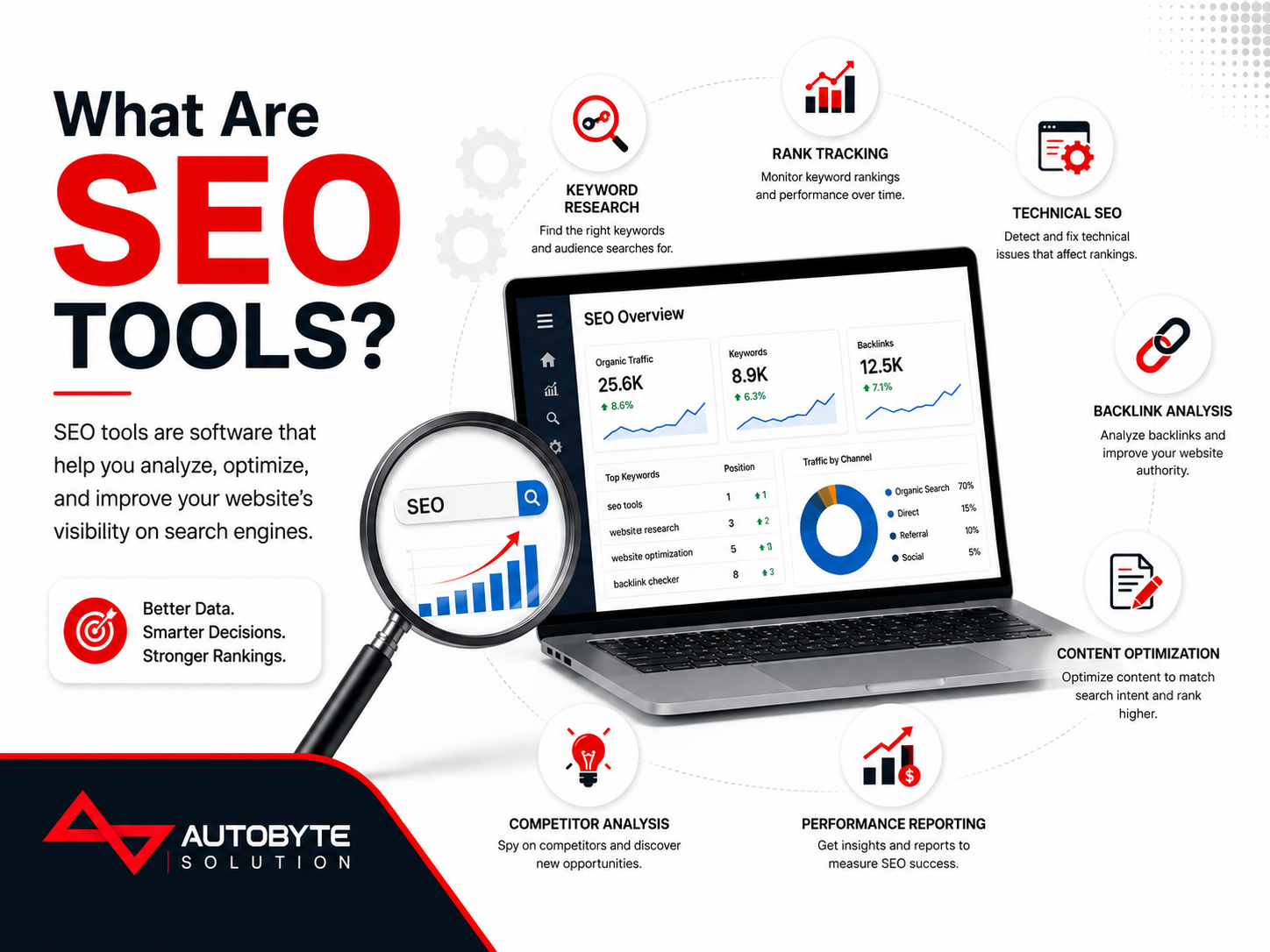
Search engine optimization involves much more than adding keywords to a website. SEO professionals need to understand how a website performs technically, what people are searching for, which pages are gaining visibility, how competitors perform, where backlinks come from, and whether organic traffic is actually contributing to business growth.
Doing all of that manually would be extremely difficult. That is where SEO tools come in.
So, What Are SEO Tools?
SEO tools are software platforms that help website owners, marketers, and SEO professionals research, analyze, monitor, and improve different aspects of organic search performance. They provide insights into keywords, rankings, backlinks, technical website issues, content opportunities, competitors, search visibility, and user behavior.
The real value comes from knowing which data matters, how to interpret it, and what actions to take next.
What Are SEO Tools?
SEO tools are software applications designed to collect and analyze information that can help improve a website's search engine optimization. Think of them as diagnostic and research instruments.
The Medical Diagnostic Analogy:
A doctor doesn't make a diagnosis simply because they have access to medical equipment. The equipment provides information that an experienced professional interprets. SEO tools work similarly.
SEO tools can uncover critical intelligence across your domain:
An SEO professional then uses those insights to determine what should actually be changed.
Why Are SEO Tools Important?
SEO involves thousands of potential data points. Imagine manually checking every page on a 5,000-page eCommerce website for broken links, missing titles, redirects, canonical tags, indexability, headings, and duplicate content. It wouldn't be practical.
Their Primary Value Chain
For example, an SEO tool might reveal that an important service page dropped from position 4 to position 15. That's useful information. But the tool doesn't necessarily tell you the complete reason. An SEO specialist must investigate whether competitors improved their pages, search intent changed, backlinks were lost, or technical issues appeared.
Tools help you find where to look. Expertise determines what to do about it.
What Can SEO Tools Do?
Different platforms serve different purposes, but modern SEO software commonly assists with:
Keyword Research
Discover what potential customers search for and evaluate search demand.
Ranking Analysis
Monitor where pages appear across search engines for priority keywords.
Technical SEO
Identify crawling, indexing, performance, and website architecture issues.
Backlink Analysis
Understand which websites link to your domain and assess link authority.
Competitor Research
Analyze competitors' keywords, top-performing pages, and link gaps.
Content Research
Discover search topics, consumer questions, and missing subtopics.
Website Performance
Analyze page speed, load latency, and technical user experience metrics.
Search Performance
Monitor real impressions, clicks, click-through rates (CTR), and queries.
Reporting & Governance
Track changes in organic performance, ROI, and pipeline over time.
Different Types of SEO Tools
There isn't one SEO tool that is automatically best at everything. Most professional SEO workflows combine several categories:
1. Keyword Research Tools
Keyword platforms estimate search volume, keyword difficulty, cost per click, search intent, and variations. Consider a web development agency:
“What is web development?”
Informational intent. The user is researching or learning.
“Web development company near me”
High commercial intent. The searcher is ready to hire.
2. Technical SEO Tools
Technical tools identify issues affecting how search engines discover, crawl, and index content: broken links, redirect chains, duplicate titles, canonical tags, XML sitemaps, status codes, and schema markup. Website crawlers simulate automated systems to produce actionable audits.
3. Rank Tracking Tools
Rank trackers monitor how a website performs for selected keywords over time:
| Keyword | Previous Position | Current Position | Change |
|---|---|---|---|
| web design services | 18 | 11 | +7 |
| local SEO company | 9 | 5 | +4 |
| SEO consulting | 21 | 13 | +8 |
| eCommerce SEO | 14 | 16 | -2 |
Note: Rankings vary based on location, device, personalization, and SERP features, which is why rankings shouldn't be your only KPI.
4. Backlink Analysis Tools
Backlink tools analyze referring domains, anchor text, new/lost links, and competitor link profiles. If respected industry sites link to competitors but not you, that reveals PR and partnership opportunities. Remember: relevance and authority matter far more than raw link counts.
5. Content Optimization Tools
Content tools highlight related subtopics, search intent, and content gaps. However, beware of the common trap: if every competitor uses the exact same software recommendations, the web fills with identical articles.
6. Competitor Analysis Tools
Competitor research reveals which keywords rivals rank for and where your gaps exist. If a competitor ranks for 3,000 queries while you rank for 800, a keyword-gap analysis identifies high-value commercial opportunities.
Popular SEO Tools and What They Are Used For
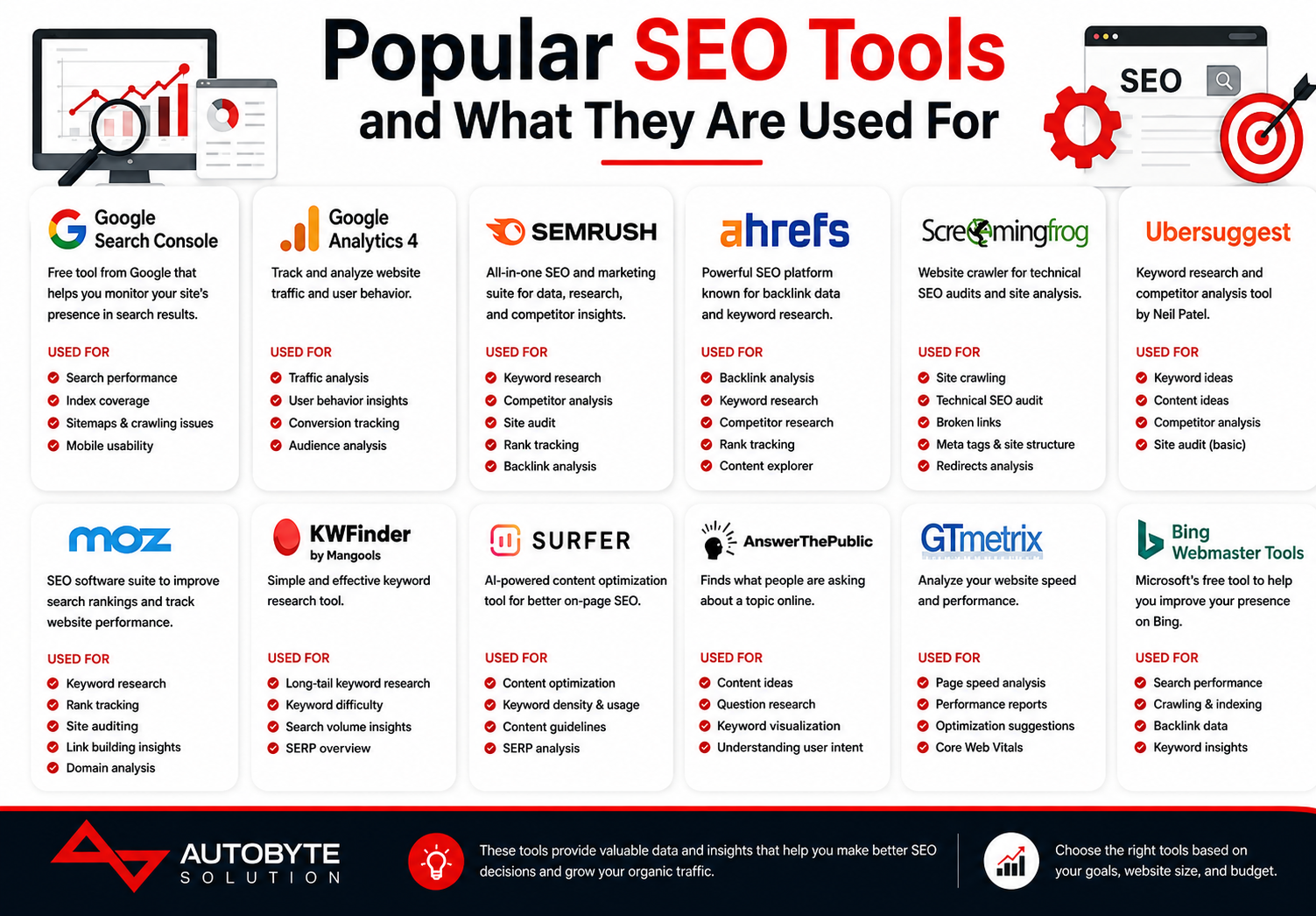
Google Search Console
The essential first-party source for understanding how Google discovers, indexes, and ranks your pages: impressions, clicks, CTR, sitemaps, and Core Web Vitals.
Google Analytics 4
Provides behavioral clarity once visitors arrive: traffic sources, user journeys, conversion paths, engagement time, and organic revenue attribution.
Semrush & Ahrefs
Comprehensive industry-standard suites for massive keyword intelligence, competitor gap audits, rank tracking, backlink authority checking, and content discovery.
Screaming Frog SEO Spider
Advanced desktop crawler simulating search engine bots to identify broken links, redirect chains, duplicate metadata, and crawl architecture bottlenecks.
Free vs Paid SEO Tools
Great for Getting Started
Google Search Console, Google Analytics 4, and Google Keyword Planner provide verified first-party data without cost. For smaller sites, this covers most basic health and performance tracking.
Essential for Scale & Competitors
Required when you need cross-domain competitor spying, massive keyword databases, historical trend archives, automated enterprise rank tracking, and large site crawls.
How to Choose the Right SEO Tools
Before subscribing to expensive software, answer these four practical questions:
1. What do I need to know?
If you need Google search performance, start with GSC. If competitor analysis, get a competitive database.
2. How large is the website?
A 5-page local company and a 100,000-SKU eCommerce portal require fundamentally different toolsets.
3. Who will interpret the data?
Sophisticated software is only as valuable as the strategist who understands what actions to take.
4. What is the actual budget?
Evaluate whether the software helps make profitable decisions, not just whether it has prestigious branding.
Can SEO Tools Improve Your Rankings?
Not directly. Subscribing to an SEO platform doesn't automatically improve your Google rankings. SEO tools provide information; improvement comes from acting intelligently on that information.
The tool identified the opportunity. The strategy and engineering execution created the change.
Do Small Businesses Need SEO Tools?
Small businesses benefit from tools, but they don't need bloated enterprise software stacks. A local service provider primarily needs visibility into search queries, local search visibility, conversions, website health, and high-priority keyword movements.
Buying more software doesn't produce better SEO. Using the right information to make profitable decisions does.
SEO Tools vs SEO Strategy: What's the Difference?
This is the most critical distinction in this guide: SEO tools tell you what the data shows. SEO strategy determines what you should do about it.
Suppose an SEO Tool Finds 500 Potential Keywords:
Should you create 500 pages? Probably not. An experienced strategist filters the dataset:
The software supplied the raw dataset. Human judgment turned it into a strategy.
What Should an SEO Tool Report Include?
Visibility
Are more relevant searches discovering the domain?
Organic Traffic
Are search engines sending qualified prospective buyers?
Rankings
Are commercial priority keywords gaining visibility?
Content Performance
Which pages are converting, declining, or showing opportunity?
Technical Health
Are critical crawl errors or latency spikes impacting UX?
Conversions & Pipeline
Are visitors booking consultations, buying, or submitting forms?
Next Actions (Crucial)
What strategic engineering tasks must happen next based on findings?
Common Mistakes When Using SEO Tools
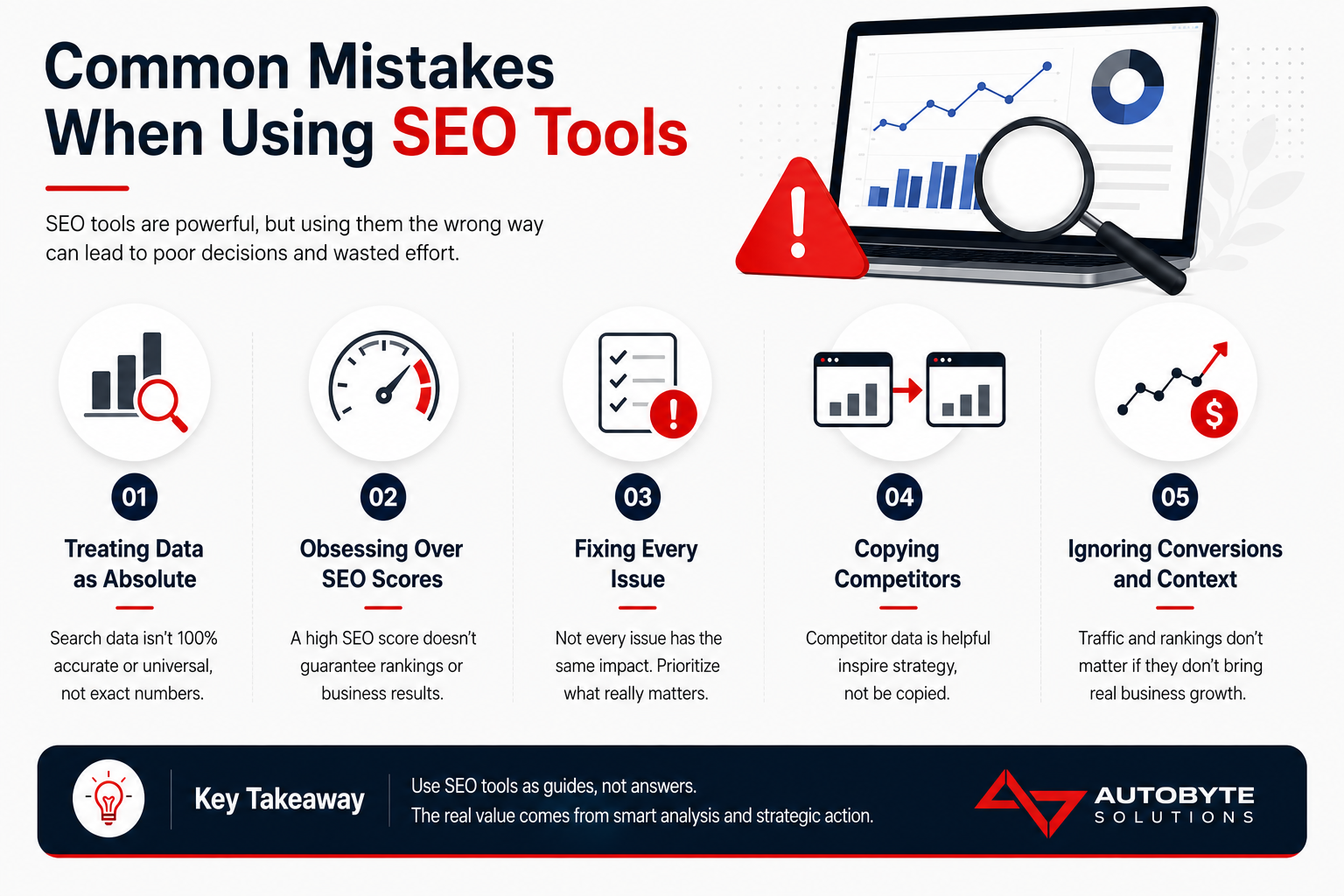
01. Treating Search Volume as Exact
Third-party volumes are historical estimates, not guaranteed real-time visitor guarantees.
02. Obsessing Over Proprietary SEO Scores
A site receiving a "92/100 tool score" does not mean it will outrank a rival with 81/100.
03. Fixing Every Minor Warning
Not every notice has equal weight. Always prioritize high-impact crawl blocks and speed bottlenecks first.
04. Blindly Copying Competitors
Competitor data should inspire differentiation and highlight gaps, not become a recipe for cloning.
05. Ignoring Conversions & Commercial Context
Traffic growth without business pipeline produces attractive vanity graphs but disappointing revenue.
Do You Need an SEO Expert If You Have SEO Tools?
Tools make SEO more accessible, but expertise still matters when competitive stakes are high. Consider this analogy: Owning professional accounting software doesn't automatically make someone an accountant.
Professional SEO services involve interpreting data within the holistic context of search intent, website architecture, business margins, competitive moats, technical constraints, and conversion funnels.
Final Thoughts: SEO Tools Provide Data — Strategy Creates Growth
The Winning SEO Equation:
Reliable Data + Expert Analysis + Clear Strategy + Quality Execution + Continuous Measurement
At AutoByte Solution, we use SEO data to move beyond surface-level metrics and understand the real problems and opportunities affecting your organic visibility. From technical SEO and keyword research to content strategy, competitive gap analysis, and performance measurement, the objective is to turn information into an actionable roadmap tied directly to revenue.
Because knowing that an SEO problem exists is useful. Knowing what to do next is where real growth begins.
AutoByte SEO Lab
Technical Search & Software Architecture
AutoByte Solution deploys data-driven SEO architectures, custom crawlers, and performance analytics to turn search intelligence into revenue.